
At 2 AM, my daughter crawled to my doorstep. Her husband’s elite family had used her as a scapegoat for their crimes, leaving her for dead. They thought they could silence me with a “non-disclosure agreement” and a threat from the local police chief. They saw a quiet florist who grows roses in the countryside. They didn’t check my fingerprints. If they did, they’d realize my file is locked behind five layers of government security. Tonight, I’m coming out of retirement for one final mission. And this time, there will be no survivors.
- Stories
Cuisine And Stories
- 0
- 11 minutes read
1. The Red Petals
The rain fell in sheets against the glass roof of the greenhouse, a steady, rhythmic drumming that usually brought me peace. I stood under the warm glow of the halogen lamps, carefully pruning a rare Black Baccara rose. Its petals were the color of dried blood, velvet-soft and dangerously beautiful. For thirty years, this was my world. Dirt under my fingernails, the smell of damp earth, and the quiet solitude of rural Virginia. I was Thomas Thorne, a sixty-year-old widower, a florist, a man who coaxed life from the soil.
Then, the doorbell of my farmhouse rang. The glowing green digits on my watch read 2:14 AM.
A cold dread, an instinct I had spent decades burying, coiled in my gut. I set down my pruning shears and walked out into the downpour, crossing the yard to the front porch.
I opened the heavy oak door and my heart stopped.
“Dad…” she breathed.
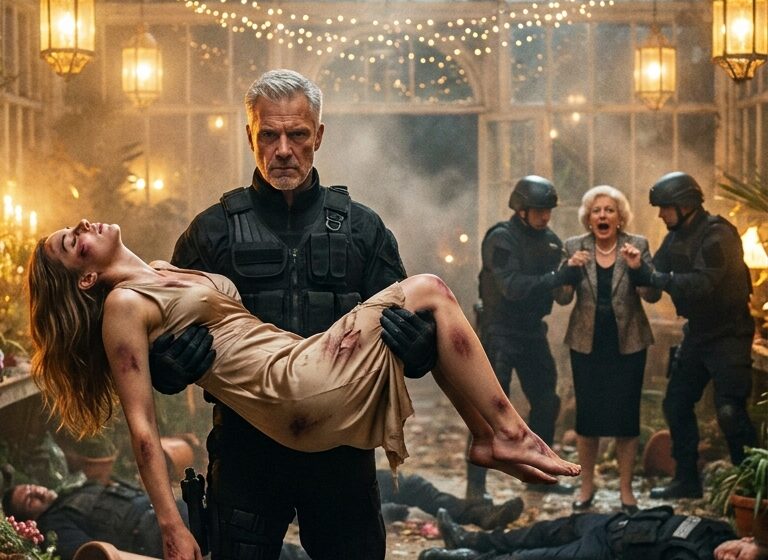
It was Lily. My daughter. But she looked like a broken doll cast out into the mud. Her designer silk blouse was shredded, soaked in rain and dark stains. Her left eye was swollen entirely shut, the surrounding skin an angry, bruised purple. A deep laceration cut across her cheek, and her wrists were raw, scraped to the bone by zip-ties.
I didn’t cry out. I didn’t panic. The warm, gentle father who sold hydrangeas died in that exact second. In his place, a man I hadn’t been for three decades opened his eyes. My hands, usually so delicate with petals, went perfectly, terrifyingly still.
I caught her as her knees buckled, lifting her feather-light frame and carrying her into the guest room. I laid her on the pristine quilt and grabbed the first aid kit from the master bathroom.
“They… they said I was the scapegoat, Dad,” Lily choked out, coughing as I gently tilted her head back to assess the laceration. Tears tracked through the grime on her face. “The embezzlement. The offshore accounts. They framed me for all of it. Julian… Julian just stood there. He watched his security team do it. He watched them beat me.”
Julian. Julian Sterling-Vance. Heir to a political and financial dynasty that treated human beings like disposable napkins.
“Shh,” I murmured, my voice devoid of tremor, a flat, metallic rasp. I took a sterile gauze pad and began to wipe a smear of mud and half-dried blood from her forehead.
“They said I was a nobody,” she whimpered, her unswollen eye looking at me with pure, shattered terror. “They said no one would look twice at a florist’s daughter. They didn’t even care who you were.”
“THEY DIDN’T CHECK MY FINGERPRINTS,” I whispered as I cleaned the blood from my daughter’s face, my gray eyes locking onto the storm raging outside the window. “Because if they had, they would have known the roses in my garden are fertilized with the secrets of men much more powerful than them.”
Lily’s breathing slowed, the trauma and the painkillers I had administered pulling her into a heavy, unnatural sleep. I pulled the blanket up to her chin. I kissed her unbruised cheek.
Then, I walked out into the storm. I bypassed the greenhouse and headed straight for the old tractor shed at the edge of the property line. The air smelled of wet pine and ozone. I stepped inside, the darkness absolute.
I walked over to a massive, cast-iron workbench bolted to the concrete. I reached under the lip of the table, my fingers tracing the rusted metal until I found the hidden, recessed plate. I pressed my right thumb against it.
A green laser scanned the ridges of my skin.
Identity Confirmed, a synthetic voice whispered.
The floorboards hissed. A section of the concrete silently sank inward, engaging a hydraulic lift that carried me thirty feet below the soil. The smell of damp earth vanished, replaced by the sterile, biting scent of gun oil and ozone. The subterranean room was bathed in dim crimson light, lined with server racks, tactical gear, and walls of classified weaponry that didn’t officially exist.
In the center of the room, sitting on a stainless-steel desk, was a single, red-coded satellite phone.
2. The Hush Money
By noon the next day, the storm had broken, leaving the Virginia countryside sweltering in the humid aftermath. I was on my knees in the front flowerbeds, a trowel in my hand, packing fresh soil around a row of daylilies. I wore faded denim overalls and a worn-out straw hat. I looked exactly like the man they thought I was.
The crunch of tires on wet gravel announced the arrival of the enemy. A black police cruiser, freshly waxed and wildly out of place on my dirt road, parked near the greenhouse.
Chief Miller stepped out. He was the local law, but his badge was bought and paid for by the Sterling-Vance family. He smelled of cheap cologne, stale coffee, and the unique arrogance of a man who thinks his uniform makes him invincible.
He walked over, his boots deliberately crushing a blooming peony. He didn’t offer a greeting. He simply tossed a thick, manila envelope onto the small wooden table where I kept my potting soil. It landed with a heavy, dense thud.
“Sign the non-disclosure agreement inside, Tom,” Miller said, resting a hand lazily on the butt of his sidearm. “And take the cash. There’s fifty thousand in there. A lot of money for a guy who plays in the dirt all day.”
I didn’t look up immediately. I carefully patted the soil around the lily. “My daughter is in bed, Chief. She has three broken ribs and a fractured orbital bone.”
“Your daughter made a mistake,” Miller sighed, leaning against the wooden post of my porch, looking utterly bored. “She played in a league she didn’t belong in. The Sterling-Vance family is untouchable, Tom. You’re a rose grower. You don’t want their lawyers turning your nursery into a parking lot. She’s lucky she’s breathing. Take the money. Move to another state. If I have to come back here, I won’t be bringing paperwork.”
I slowly stood up, brushing the dirt from the knees of my overalls. I picked up the trowel, feeling the familiar, reassuring weight of the wooden handle. I looked at the pen resting on top of the envelope, then up at the Chief’s gleaming silver badge.
“I’ve spent my life watching things grow, Chief,” I said, my voice adopting the mild, slightly shaky cadence of an intimidated old man. “I’ve learned that some things need to be pruned so the rest can survive.”
Miller let out a short, barking laugh. “You’re a poet, Tom. Just sign the damn paper.”
As he laughed, he turned his head to spit a stream of sunflower seeds into the grass. In that microscopic fraction of a second, my hand moved. It was a fluid, invisible motion—a ghost of a reflex. I brushed his hip as I reached for the pen, sliding a magnetic, microscopic GPS tracker smaller than a grain of rice perfectly onto the underside of his leather holster.
“I’ll need to read it first,” I mumbled, keeping my eyes downcast.
“You do that,” Miller sneered, turning his back on me and walking to his cruiser. “But don’t take too long. My patience isn’t what it used to be.”
I watched his car disappear down the dusty road, calculating the exact trajectory of his route back to the city. My demeanor shifted. The faux-tremble in my hands vanished.
I walked inside, locked the doors, and took the hidden elevator back down into the red-lit abyss of my bunker. I picked up the red satellite phone and punched in a thirteen-digit sequence that hadn’t been active since the Cold War ended.
It rang once.
“Directorate,” a voice answered. Cold, professional, devoid of humanity.
“Unit 7-Alpha,” I said, staring at the wall of weapons. “Master Sergeant Thorne.”
There was a silence on the line so profound I could hear the hum of the encrypted servers bouncing off satellites in low orbit.
“We thought you were a ghost, Sergeant,” the voice finally replied, a distinct edge of awe bleeding through the professionalism.
“I need the orbital signatures for the Sterling-Vance estate in Connecticut,” I stated, my voice as hard as diamond. “I need the architectural blueprints, the private security frequencies, and the offshore routing numbers. And tell the President’s security detail…” I racked the slide of a matte-black suppressed pistol, chambering a round. “…their teacher is back on the clock.”