

At 1:00 a.m., I found my daughter collapsed at the door, her lip split, one eye swollen shut. Through tears, she whispered, “Mom… please don’t make me go back.” I’d brought down violent men my entire career—but never imagined my own son-in-law was one of them. That night, I put the uniform back on… and became the woman who would destroy him.
- Stories
Cuisine And Stories
- 0
- 10 minutes read
1. The Midnight Arrival
The Arizona heat had finally surrendered to the cool, dry desert night. It was 1:00 a.m.
I had spent more than two decades wearing a badge for the Phoenix Police Department, working as a senior detective in the Violent Crimes unit. I had seen the absolute worst of humanity. I had stood over bodies in alleys, processed gruesome domestic homicide scenes, and sat across interrogation tables from men with eyes as dead as river stones. I thought my career had hardened me. I thought I had built a psychological callous thick enough to withstand any horror the world could throw at me.
But nothing—no crime scene tape, no sterile autopsy report, no frantic dispatch call—prepared me for the moment I opened my own front door and found my personal nightmare bleeding on my welcome mat.
The doorbell had rung a frantic, continuous, desperate rhythm that jolted me from a light sleep. I grabbed my service weapon from the nightstand out of sheer instinct and hurried down the dark hallway.
I flipped the porch light on and pulled the heavy oak door open.
My daughter, Lena, swayed unsteadily under the harsh yellow bulb.
For half a second, my brain simply refused to process the visual information it was receiving. The woman standing before me was not the vibrant, confident twenty-six-year-old who had smiled radiantly in her wedding photos three years ago.
Lena’s lower lip was split wide open, a fresh, dark trail of blood tracking down her chin and staining the collar of her thin, torn sweater. Her left eye was already swollen into an ugly, deep purple slit, the surrounding skin puffy and inflamed. She was hunched over, her arms wrapped tightly around her midsection, clutching her stomach as if trying to hold herself together. Her breathing was a series of shallow, ragged, painful gasps.
“Mom…” Lena whispered.
Her voice cracked, breaking into a raw, guttural sob that tore my soul completely in half. It was the sound of an animal caught in a trap, entirely devoid of hope.
“Please don’t make me go back,” she pleaded, her knees buckling slightly.
“Lena!” I screamed, dropping my weapon onto the entryway table and lunging forward to catch her before she collapsed onto the hard concrete of the porch.
For one agonizing moment, the twenty-year veteran detective vanished completely. I was just a mother, drowning in a sudden, violent, suffocating wave of primal panic. I pulled her inside the house, kicking the front door shut and locking the deadbolt behind us.
As I helped her toward the living room sofa, my hand brushed against her ribs. Lena flinched violently, a sharp, involuntary hiss of pain escaping her bruised lips. She curled away from my touch, protecting her side.
My training slammed back into my brain with the force of a freight train, overriding the panic.
I recognized the defensive posture. I recognized the specific pattern of the bruising forming on her cheekbone and neck. This wasn’t a single, impulsive shove during a heated, escalating argument. This was a sustained, deliberate, calculated beating. Someone had used their fists to systematically dismantle her.
I eased her down onto the soft cushions of the sofa. My hands were shaking, but my mind was rapidly, terrifyingly clearing.
“Who did this to you, baby?” I asked, my voice dropping to a low, steady, demanding register. I already knew the answer, but I needed her to say it.
Lena squeezed her eyes shut, fresh tears mixing with the blood on her face. She took a ragged breath, clutching her stomach tighter.
“Eric,” she whispered.
The hot, suffocating panic in my chest vanished instantly. It was replaced by a cold, absolute zero. The kind of freezing, calculated clarity that descends right before a tactical breach.
Eric.
The charming, fiercely successful, wealthy architect with the firm handshake, the expensive tailored suits, and the easy, disarming smile. The man who owned a sprawling house in the most exclusive suburb of Scottsdale. The man who always seemed to answer questions for Lena at family dinners, subtly cutting her off, slowly and methodically erasing her vibrant, independent personality over three years of marriage under the guise of being “protective.”
My first, overwhelming instinct was to grab my Glock from the table, drive my truck straight to their pristine suburban house, kick his custom mahogany door off its hinges, and drag Eric out onto his manicured lawn by his throat. I wanted to feel his jaw break under my hands.
But twenty years on the force had taught me one undeniable, fundamental truth about monsters like Eric: Rage is a gift to abusers. Rage makes mistakes. Rage gets you arrested, leaving the victim entirely unprotected.
Evidence wins. Evidence destroys them.
“Okay,” I said, my voice perfectly calm. I didn’t offer empty platitudes. I didn’t scream his name. I stood up and walked to the hall closet.
I grabbed my heavy, digital DSLR camera—the one I used to document crime scenes before the forensics team arrived. I grabbed a fresh SD card and a sterile evidence bag from my “go-bag.”
“We are doing this the right way, Lena,” I said softly, returning to the living room and kneeling beside her. “The permanent way.”
I helped her up, wrapping a warm blanket around her trembling shoulders. I guided her out to my truck, the cold desert air biting at our skin. I was already building the criminal case against my son-in-law in my head, calculating charges for aggravated assault and domestic battery.
I thought I knew what I was dealing with. A wealthy, arrogant wife-beater.
I didn’t know that the purple bruises on my daughter’s skin were just the surface ripples of a much deeper, darker, and infinitely more terrifying crime.
2. The Hidden Fracture
The emergency room at St. Luke’s Medical Center was a chaotic blur of harsh fluorescent lights, the smell of antiseptic, and the low, constant hum of medical machinery.
I didn’t wait in line at triage. I bypassed the crowded waiting area, walked directly up to the intake desk, and flashed my gold detective’s shield. The triage nurses took one look at my badge, and then at the battered, bleeding, terrified woman leaning heavily against me, and they moved with immediate, practiced urgency.
They recognized the look in a fellow officer’s eyes. It was the look that said: Do not ask questions. Just move.
Within five minutes, Lena was situated in a private, secure trauma bay in the back of the ER. A team of nurses worked efficiently to clean her wounds, start an IV, and monitor her vitals.
While they worked to stabilize my daughter physically, I officially stepped into the role of her lead investigator.
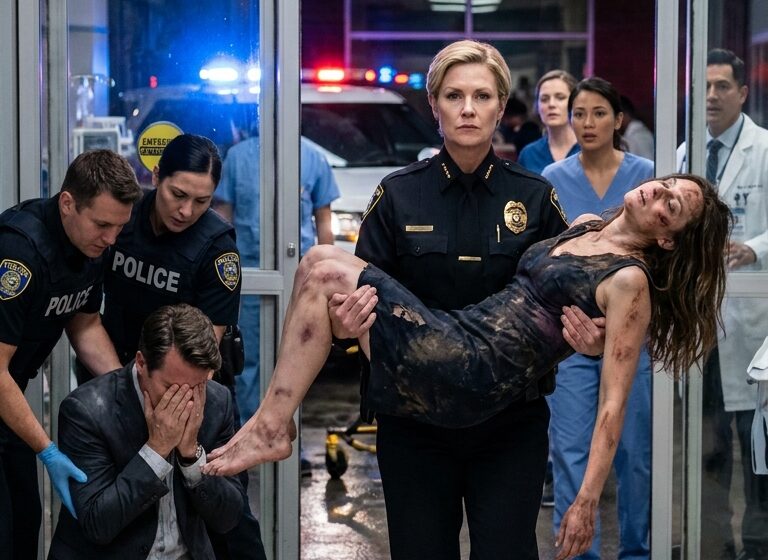
I pulled out my digital camera. I didn’t let my hands shake. I systematically, clinically photographed the deep, finger-shaped bruising forming on her neck—the undeniable hallmark of manual strangulation. I photographed the jagged lacerations on her split lip and swollen eye. I documented the defensive scratch marks and bruises on her forearms, where she had tried to shield her face from the blows.
I requested a sterile evidence bag from a nurse and carefully secured Lena’s blood-stained, torn sweater for potential DNA analysis.
“Mom,” Lena whispered weakly from the hospital bed, her good eye tracking my movements. “My phone… it’s buzzing.”
I walked over to the small plastic table where the nurses had placed her belongings. I picked up her smartphone. The screen was lit up with a barrage of incoming text messages.
They were all from Eric.
I didn’t hesitate. I used her passcode to unlock the phone and began rapidly screenshotting the messages, sending the images directly to my secure, encrypted work email.
The messages weren’t apologies. They weren’t the frantic texts of a worried husband. They were a chilling, escalating timeline of sociopathic control.
1:15 AM: You’re making a massive mistake, Lena.
1:22 AM: If you tell your mother anything, if you tell the police, I will absolutely ruin you. You know I can.
1:30 AM: Come home right now before I have to come find you and make you.
He was establishing a documented pattern of witness intimidation and terroristic threats. He was handing me the rope to hang him with.
An hour later, the curtain to the trauma bay was pulled back. Dr. Aris, a seasoned ER attending physician I had worked with on dozens of assault cases over the years, stepped into the room. His face, usually a mask of calm professionalism, was incredibly grim.
He didn’t look at Lena. He looked directly at me and gestured with his head toward the hallway.
I followed him out of the room, the heavy automatic doors sliding shut behind us, muting the sounds of the ER.
“Pat,” Dr. Aris said quietly, keeping his voice low. “We did a full-body CT scan because of the severe abdominal guarding she was presenting with, and her complaints of intense pain in her lower quadrant.”
“And?” I asked, my stomach knotting tightly. “Did he rupture her spleen? Punctured lung?”
“She has two fractured ribs on her left side,” Dr. Aris replied, looking down at the chart in his hands. “But that isn’t my primary concern right now.”
The bottom dropped out of my stomach. “What is it, Aris? Tell me.”
Dr. Aris looked up, his eyes filled with a deep, profound sorrow.
“She has significant, active internal bleeding in her uterus,” he said, his voice dropping to a horrified whisper. “Pat… Lena was eight weeks pregnant. The blunt force trauma she sustained to her abdomen was catastrophic.”
The hallway seemed to tilt violently. The buzzing of the fluorescent lights suddenly roared in my ears like a jet engine.
“She’s losing the baby, Pat,” Dr. Aris said gently, placing a hand on my shoulder to steady me. “The fetal heartbeat is gone. The hemorrhage is severe. We have to take her up to emergency surgery immediately to stop the bleeding, or we’re going to lose her, too.”