
My Brother Thought That Writing My Name On A Piece Of Paper Could Replace My Consent. For Seven Years, My Family Treated My Time As If They Owned It. What He Did Not Know Was That I Had Brought Years Of Messages, Receipts, And Evidence Showing Exactly How That Family Had Operated.
- Stories
Cuisine And Stories
- 0
- 6 minutes read
Part 2 of 3
“I did not agree to watch them.”
“That is why we need your statement.”
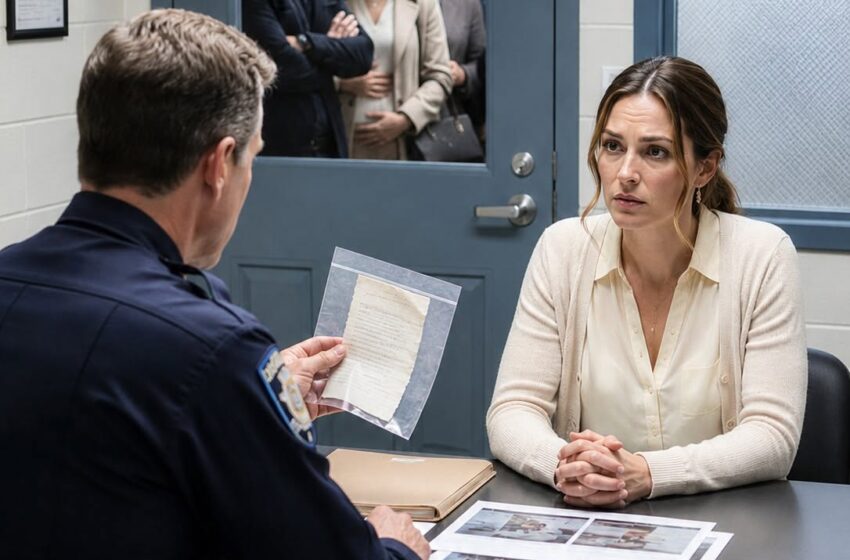
Forty minutes later, I sat in a small interview room under fluorescent lights with my evidence folder on my lap. Officer Price was in his forties, tired-eyed and professional, with the controlled patience of someone who had seen too many adults explain away danger after it almost became tragedy.
He placed a clear evidence sleeve on the table. Inside was a torn sheet of notepaper.
I recognized Brooke’s handwriting immediately.
The kids are with Ava until 1:00. She knows and agreed. Had an urgent prenatal appointment.
Advertisements
I stared at the words until they blurred.
“That is a lie.”
“Did either parent contact you last night or this morning requesting childcare?”
“No.”
“Do you have documentation of your refusal yesterday?”
I opened the folder and slid printed screenshots across the table.
“This is from yesterday after the backyard gathering. This message from Brooke at 10:17 p.m. says, ‘You will regret humiliating us. Nobody abandons family and walks away clean.’ This one from Caleb says, ‘Do not test me, Ava. You know we need you tomorrow.’ I did not respond because I had already said no in front of everyone.”
Officer Price read carefully. His expression changed with each page.
I added the summary log.
“This folder also shows years of them treating me as an unpaid caregiver without consent. It may not be criminal by itself, but it explains why they believed they could write my name on a note and make it true.”
He closed the folder slowly.
“This changes the nature of the incident. We are no longer looking at confusion over a caregiver schedule. We are looking at possible child neglect, false statements to law enforcement, and fabricated documentation involving an unwilling third party.”
My knees weakened with relief and horror at the same time.
Before I could answer, shouting broke out in the hallway.
The door opened, and my mother entered first, pale and shaking. My father stood behind her, his face gray with shame. Caleb came next in a wrinkled business shirt, anger covering fear. Brooke appeared last, one hand on her stomach and the other clutching an expensive handbag like a shield.
“Ava,” Brooke cried, pointing at me. “How could you do this to us? You called the police on a pregnant woman and her family?”
Officer Price stepped between us.
“Mrs. Bennett, Ms. Bennett did not call the police. A neighbor called 911 after your three-year-old was found alone near a busy road.”
Brooke’s mouth closed.
Caleb tried to recover.
“Officer, this is a family misunderstanding. Ava has watched the kids for years, and we had an urgent appointment. We assumed she would come by like usual.”
Officer Price lifted the note.
“Who wrote this statement saying Ms. Bennett knew and agreed?”
No one spoke.
But Caleb looked at Brooke, and my mother looked at Brooke, and Brooke looked at the floor.
Sometimes silence becomes the first honest witness.
3. The System They Could Not Manipulate
Officer Price sat down again, his voice flat with authority.
“Mrs. Bennett, did you knowingly write a false note assigning childcare responsibility to a person who had not consented?”
Brooke began to cry.
“I thought she would come. She always comes. She does not have a family of her own, and she knows how hard things are for us.”
“That was not my question.”
Caleb rubbed both hands over his face.
“We made a mistake.”
“A mistake is forgetting a lunchbox,” Officer Price said. “Leaving four children unsupervised and falsely naming a caregiver is not a scheduling error.”
My mother reached for me, but I stepped back before her hand landed.
“Ava, tell them you do not want charges. Think of the children. Think of the baby coming.”
That sentence pulled a cold breath through me.
“I am thinking of the children. Jonah could have been hit by a car this morning while everyone was busy blaming me for not being available.”
My father covered his face.
For the first time in my adult life, he spoke before my mother could smooth the room into something easier.
“She is right,” he said quietly. “We let this happen. We all did.”
Elaine looked at him as though he had betrayed her.
He looked at me.
“I am sorry, Ava. I told myself you were strong enough to handle it because it was easier than admitting we were using you.”
The apology did not fix anything. It did not give me back weekends, sleep, money, or years of being told my chosen life was less real. But it landed somewhere honest, and honesty had been rare in our family.
“Thank you,” I said. “But the system you built around me is over.”
The case did not become a dramatic arrest scene. Real consequences often begin with forms, interviews, and social workers who carry clipboards instead of handcuffs. Child Protective Services opened a full investigation. Caleb and Brooke received an official neglect finding tied to inadequate supervision and false caregiver information. Their household was placed under monitoring for six months, with mandatory parenting classes, unannounced home visits, and a verified childcare plan required before either parent could leave the children unattended for appointments, work, or social events.
The hardest blow for them came from math.
Without me, childcare became a market rate service.
Caleb and Brooke learned that qualified childcare for four young children in Charlotte cost more than Brooke’s monthly content sponsorships and more than Caleb wanted to admit their household could spare. Professional nannies quoted hourly rates that made Brooke’s mouth fall open. Emergency backup care charged premiums. Preschool extensions required deposits. The luxury of my unpaid availability had been hiding thousands of dollars in labor every month.
Brooke shut down her motherhood lifestyle account within two weeks after neighbors began whispering. Her carefully edited image of effortless abundance did not survive the story of a barefoot toddler on Ardmore Parkway. Caleb took on extra work and complained through relatives that I had destroyed their finances by refusing to help the way family should.
See more on the next page