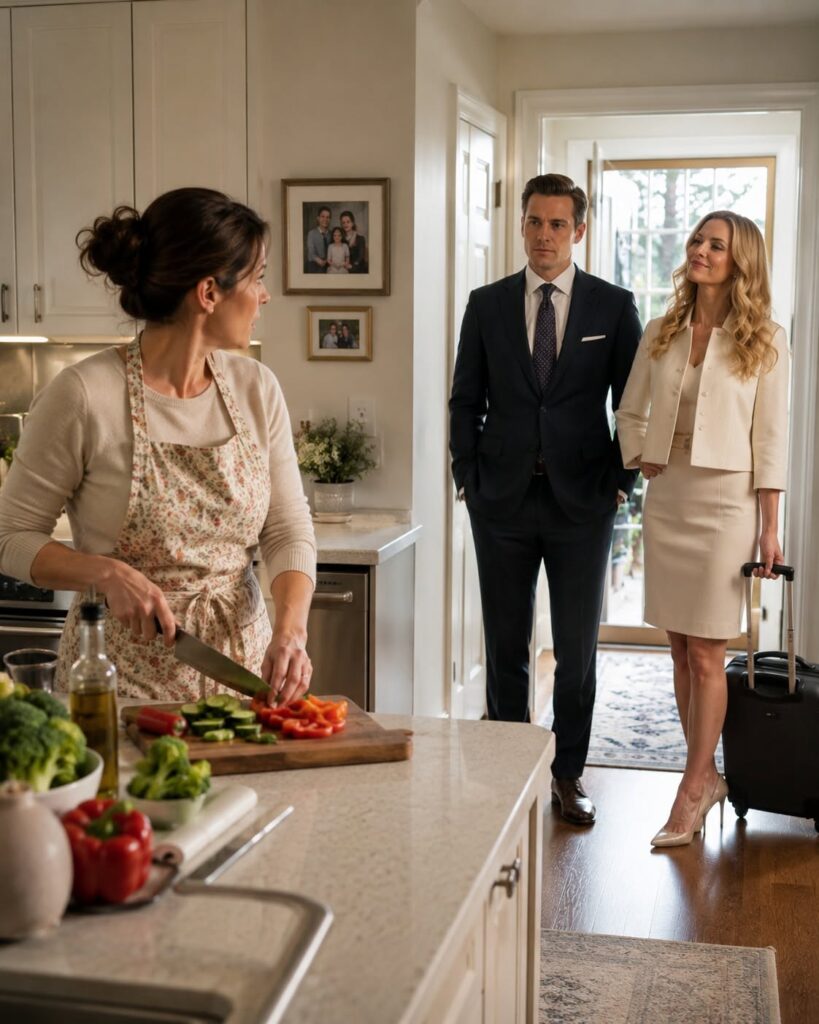

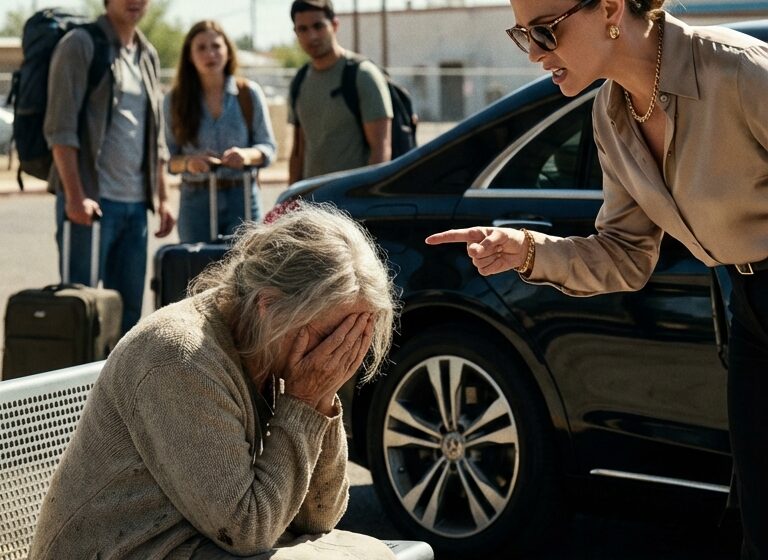
My daughter left me at a bus terminal. “Stay here, Mom. There’s a better place for you—somewhere you won’t be in the way.” I waited three hours under the sun… until I took out my phone and called my private attorney. Three days later…
- Stories
Cuisine And Stories
- 0
- 20 minutes read
Chapter 2: The Architecture of Deceit
Ferrero, my legal counsel and a man who possessed a frankly terrifying understanding of human greed, had told me once that if anyone ever attempted to make me disappear quietly, the absolute first line of defense was the establishment of an impenetrable, unimpeachable timeline.
I remained planted on that miserable plastic bench for an eternity. I became a ghost in the terminal, a fixture of the architecture. I watched transient souls, exhausted mothers, and restless drifters move through the concourse, none of them sparing more than a passing, pitying glance at the old woman sitting alone with a cloth bag.
Waiting in a state of enforced stillness does something peculiar to the human brain. It hollows out a vast, echoing space in your mind, forcing you to revisit recent traumas whether you desire the retrospective or not. My consciousness violently pulled me backward, dragging me to the mahogany table in my Sellwood kitchen exactly seven days prior.
The memory tasted of cold chamomile tea. Nancy had been pacing the hardwood floor like a caged panther, the frantic click-clack of her heels betraying her escalating panic. I had been sitting perfectly still, my hands wrapped around a porcelain mug whose warmth had long since vanished.
“Mom, you aren’t listening to me! We can fix everything. All of it. If we just liquidate the house,” she had pleaded, her voice cracking with a terrifying mixture of anger and terror.
I remembered looking at her—really looking at her, trying to find the little girl who used to plant sunflowers in the backyard—before delivering my response. “The property is not for sale, Nancy.”
Her shoulders had immediately corded with tension, locking into a rigid, defensive posture. It was her tell. It was the physical manifestation of her trying to seize control of a narrative slipping through her fingers.
“You don’t understand the gravity of how bad this is!” she had shouted, abandoning all pretense of a measured conversation. “The Bend real estate deal totally collapsed. Mark’s construction loan is an absolute, unmitigated disaster, and the bank is already sending threatening notices. They are going to ruin us.” She stopped her frantic pacing, planting her hands flat on the kitchen table and leaning into my personal space. “If we sell this house, we clear the debt entirely. We wipe the slate clean. We start over.”
We, she had said. As if my life’s work was merely collateral for her husband’s reckless gambling.
I hadn’t raised my voice. I had never needed to rely on volume to command respect in my own home. “The house is mine,” I stated, the words heavy and immovable as river stones. “And it is the singular, stable foundation either of us has left in this world. I will not burn my sanctuary to keep Mark warm.”
That was the moment the mask slipped. She had reached into her designer leather tote, pulling out a thick, stapled sheaf of legal documents, sliding them across the polished wood until they bumped against my cold teacup.
“Then just sign this,” she had demanded, her tone suddenly chillingly pragmatic. “It just grants me the temporary authority to handle the complex paperwork on your behalf, so we can move quickly when the market shifts.”
I had retrieved my reading glasses from my breast pocket. I read the first page. I didn’t skim it; I read the agonizingly dense legalese word for word. It was not a temporary proxy for administrative duties. It was a comprehensive, irrevocable quitclaim deed. It was a full transfer of the estate.
Her face underwent a horrifying metamorphosis right before my eyes. The facade of the concerned, struggling daughter evaporated into thin air. The artificial patience drained out of her features so completely that I immediately understood the insult: she had genuinely expected me to be too blind, too tired, or too foolish to actually read the contract.
“It’s just a temporary measure,” she had stammered, scrambling to patch the hole in her lie. “Just a placeholder until we navigate out from under this avalanche.”
“No,” I had answered, sliding the documents back across the table with a firm, dismissive push. “It isn’t.”
She hadn’t argued further. She hadn’t apologized. She had simply snatched the papers, her movements jerky and erratic, shoving them back into her bag. “You’re being an obstinate old fool,” she had hissed, the venom in her voice unmistakable. “You would honestly rather sit here in your empty museum and watch your own flesh and blood drown.”
That had been the final, fatal exchange before the silent ride to the bus station.
Sitting there on the bench, letting the hours bleed together, my perception of my environment began to sharpen. My eyes began to map the terminal. I noted the black dome of a security camera mounted directly above the main ticket counter. I spotted a second one angled strategically toward the central seating area. A third was positioned flush against the brickwork near the sliding glass entrance.
I subtly adjusted my posture, shifting my weight so that the lens near the ceiling had a completely unobstructed, undeniable view of my face and my location.
Small details, Ferrero’s voice echoed in my head. They become the nails in the coffin.
I wasn’t consumed by a fiery, passionate desire for revenge. Revenge is a young man’s game; it burns too hot and consumes the vessel. I was seeking absolute clarity. And clarity, I was learning, often begins by simply planting your feet in the dirt and remaining perfectly still until the lies burn away and the truth becomes undeniably visible.
I let three full hours tick by on my watch before I finally unzipped the faded cloth bag Nancy had tossed at me. By then, the molded plastic had bruised my lower back, and the chaotic symphony of air brakes and shouting drivers had faded into a dull, rhythmic hum.
If the facts are unequivocally on your side, Ferrero had instructed, time is your greatest ally. Patience gives the truth the oxygen it needs to ignite.
I remembered those exact words as my fingers probed the inner lining of the bag. Deep in the seam, my fingers brushed against cold, hard plastic. I pulled it free. It was the prepaid, untraceable smartphone Ferrero had handed me across his desk two months prior.
We had been sitting in his high-rise office in downtown Portland. He had been meticulously reviewing a separate, seemingly innocuous set of tax documents Nancy had been pressuring me to sign. After a protracted silence, he had leaned back in his leather chair, steepling his fingers beneath his chin.
“Severe financial hemorrhage alters a person’s fundamental chemistry, Aan,” he had warned me, his voice a low rumble. “It strips away morality faster than we ever anticipate.”
I hadn’t explicitly argued with him, but the stubborn mother inside me refused to fully swallow the bitter pill. Nancy was ruthless, yes. She was relentlessly determined. But she was still the child I had taught to ride a bicycle.
Ferrero had simply sighed, opened his desk drawer, and slid the small, black device across the polished mahogany. “Bury this somewhere she will never look. If the atmosphere ever shifts, if the pressure drops and something feels fundamentally wrong… you press one. It dials me directly.”
I had tucked it into the lining of the old tote bag and genuinely forgotten about its existence. Until today.
Sitting in the dim light of the terminal, I powered the device on. The screen flared to life. I pressed the number one. The connection rang precisely twice before it was intercepted.
“Speak,” Ferrero’s voice clipped through the receiver, sharp and alert.
“Aan here,” I breathed, feeling the first tremor of adrenaline in my chest. “I am currently sitting in the Greyhound station on Northwest Station Way.”
A heavy, weighted pause stretched across the cellular connection. “Did she actually leave you there?”
“Yes. She took my primary phone. She destroyed the SIM card. She handed me a one-way ticket east and drove away.”
I could hear the faint scratch of a fountain pen on paper on his end. “Are there closed-circuit cameras in your immediate vicinity?”
“Three. One has a direct line of sight to my position.”
“Excellent,” Ferrero commanded, his tone dropping an octave into pure, tactical execution. “Do not move a single muscle unless your physical safety is compromised. I want the digital timeline of your abandonment to be flawlessly documented. I am leaving my office now. I will collect you in twenty minutes.”
The line went dead.
For the first time since my daughter had pulled away from the curb, I allowed my lungs to fully expand, pulling in a deep, ragged breath of stale air. I looked down at the crumpled ticket resting in my palm. Nancy had arrogantly believed this cheap piece of paper would permanently erase a problem from her ledger.
What my desperate daughter failed to comprehend was that she hadn’t discarded me. She had merely handed me the exact weapon I needed to dismantle her entire life.
Chapter 3: The Counter-Strike
Ferrero materialized at the terminal doors faster than the Friday traffic should have allowed. He didn’t waste oxygen on pleasantries or frantic questions. He simply pushed open the heavy glass door, locked eyes with me, and gave a sharp nod toward his idling sedan.
Once safely ensconced in the quiet, leather-scented sanctuary of his office, the real work began. He arranged a series of legal documents into a pristine, intimidating stack on his desk.
“Your daughter made a catastrophic miscalculation,” Ferrero stated, tapping a silver pen against the paperwork. “Following your cataract surgery last winter, she was granted a highly specific, limited power of attorney designed strictly to manage routine medical billing and localized financial matters. It was a convenience, not a coronation.”
He flipped to the third page, highlighting a dense paragraph of text. “Nothing in the architecture of this document ever bestowed upon her the legal authority to transfer, leverage, or liquidate the Sellwood property. She is operating under a delusion of power.” He pointed to a specific clause. “Notice the expiration date and the strict financial caps hardcoded into the agreement.”
He pulled a fresh, unblemished document from a manila folder and centered it in front of me. “We are executing a full, immediate revocation of that limited authority as of this exact minute,” he said, uncapping his pen and offering it to me. “Her digital access to your banking infrastructure is being severed simultaneously.”
I took the pen. It felt heavier than it should have.
Ferrero peered at me over the rim of his glasses. “Furthermore, the act of abandoning a senior dependent at a transit terminal establishes a pristine, undeniable timeline of elder neglect and endangerment. She hasn’t just overstepped her bounds; she has fundamentally incriminated herself.”
I rested my hands on my knees, staring blindly at the plush carpet. “I never, in my darkest nightmares, imagined it would devolve into this.”
Ferrero leaned back, the leather of his chair groaning softly. “Desperation makes monsters of us all, Aan. Now, we remove emotion from the equation. We let the cold, hard facts speak for themselves.”
While I sat in the safety of the law office, Nancy firmly believed her ruthless gambit had succeeded flawlessly. The sequence of events that unfolded that evening in my home—her home, she assumed—was pieced together later through Ferrero’s meticulous subpoenas, digital access logs, and the panicked confessions of the real estate agent she unwittingly dragged into the crossfire.
Nancy and Mark were reportedly sitting at my antique dining table when she popped the cork on a bottle of vintage sparkling wine she had been chilling in my refrigerator for weeks. Mark, whose jaw had been clenched so tight for the past month I thought his teeth might shatter, visibly deflated the moment the alcohol flowed.
“So? Is it done?” Mark had asked, his voice rough with anxiety.
Nancy had offered a smug, victorious nod. “By now, the bus is crossing the state line. He’s out of the picture.” She took a long, celebratory swallow of wine. “I officially list the property tomorrow morning. If we price it aggressively and it moves fast, we can finally get ahead of the creditors.”
Mark slumped back in his chair, running a hand over his face. “If we pull this off, that covers the immediate two hundred thousand of the Bend construction loan. We can breathe again.”
For the first time in an eternity, the two of them genuinely believed they had outrun the avalanche of their own incompetence.
Brimming with false confidence, Nancy had cracked open her laptop, navigating to the website of a high-end local real estate broker she had been secretly consulting. She initiated the onboarding process, inputting the baseline specifications of my property into their digital portal. Halfway through the requisite forms, the system prompted her for a nominal processing fee to activate the listing.
She retrieved her leather wallet, extracting a platinum credit card irrevocably linked to my primary checking account, and punched in the digits.
The screen spun for a fraction of a second before flashing red: TRANSACTION DECLINED.
She scowled, assuming a mere network error, and re-entered the security code.
DECLINED.
Mark glanced up from his glass. “Did you use the wrong card?”
“No,” Nancy muttered, a faint prickle of unease finally piercing her veil of victory. She snatched her phone, aggressively launching her mobile banking application. The loading icon cycled endlessly for ten agonizing seconds.
Then, a sterile, gray dialog box materialized: ERROR 403: ACCESS REVOKED. PLEASE CONTACT BRANCH MANAGER.
She stared at the glowing rectangle, her pulse suddenly hammering against her ribs. She forcefully refreshed the interface. The same apocalyptic warning persisted.
Mark rose from his chair, the color draining from his face as he stepped behind her to read the screen. “Nancy… what exactly does that mean?”
“I don’t know,” she whispered, the sparkling wine suddenly turning to acid in her stomach.
Before she could form another thought, her phone vibrated violently against the wood. The caller ID flashed the name of the real estate broker. She swiped to answer, her voice artificially bright. “Hi, Sarah! I was just trying to submit the—”
“I am so sorry to interrupt, Nancy,” the broker’s voice cut through the air, vibrating with professional panic. “I am calling to inform you that my agency has just been served with an expedited cease-and-desist order from a corporate attorney representing Aan Merik.”
The silence in the kitchen became absolute, suffocating. “What kind of notice?” Nancy choked out, her throat suddenly parched.
“The notice explicitly states that you possess zero legal authority to list, broker, or sell the property at that address. It also references pending allegations of financial misconduct. Nancy, I have to withdraw my representation immediately. Please do not contact this office again.” The line clicked dead.
In a matter of seconds, the illusion of her triumph shattered into a million jagged pieces. The trap hadn’t snapped shut on me. It had snapped shut on her.
For the next forty-eight hours, Ferrero and I operated in total silence, methodically tightening the noose. It was the clinical, dispassionate work of men who know that victory is found in the minutiae.
We initiated the process by securing the digital footage from the Greyhound terminal. Ferrero’s paralegal hand-delivered a preservation order to the station manager. By nightfall, we had high-definition verification: the camera perfectly captured my abandonment, Nancy’s swift confiscation of my property, and her immediate departure.
“The timeline is now bulletproof,” Ferrero stated as we reviewed the grainy video on his monitor. “It unequivocally demonstrates forced abandonment. We’ve also secured a sworn affidavit from a janitorial staff member who noted your continuous presence on that bench for nearly four hours.”
Next came the telecommunications data. The stamped metadata from my burner phone confirming my distress call to his office locked the final piece of the chronology into place. The narrative of the helpless, discarded elder was legally ironclad.
On Wednesday afternoon, Ferrero slid a thick, leather-bound portfolio across the desk. It was significantly heavier than the previous documents.
“My last will and testament,” I breathed, staring at the embossed cover.
Ferrero nodded, his face unreadable. “You instructed me to draft the revisions.”
For decades, it had been a foundational, unquestioned truth that the house in Sellwood would pass to my daughter upon my death. I had structured my entire legacy around that singular assumption, the way a parent foolishly conflates unconditional love with guaranteed loyalty.
I let my hand rest on the leather for a long time. The silence in the office was absolute.
“I kept waiting,” I confessed, my voice barely above a whisper. “I kept waiting for the fever to break. For her to wake up and realize what she was doing. I never… I never thought I would have to build a fortress to protect my own home from my own child.”
Ferrero didn’t offer hollow platitudes. He didn’t offer sympathy. He offered the cold, unforgiving truth. “When the water reaches a drowning person’s chin, Aan, they will climb on the shoulders of anyone to survive. Even their own father.”
I exhaled slowly, opening the portfolio and picking up the pen. I signed my name, severing the final thread of inheritance. I closed the book.
“When do we return to Sellwood?” I asked, my voice suddenly devoid of all hesitation.
Ferrero checked his watch, a predatory glint finally appearing in his eye. “Tomorrow morning. Exactly seventy-two hours after she left you in the terminal. We let her stew in her own panic just long enough for it to become unbearable.”
rede more page 3