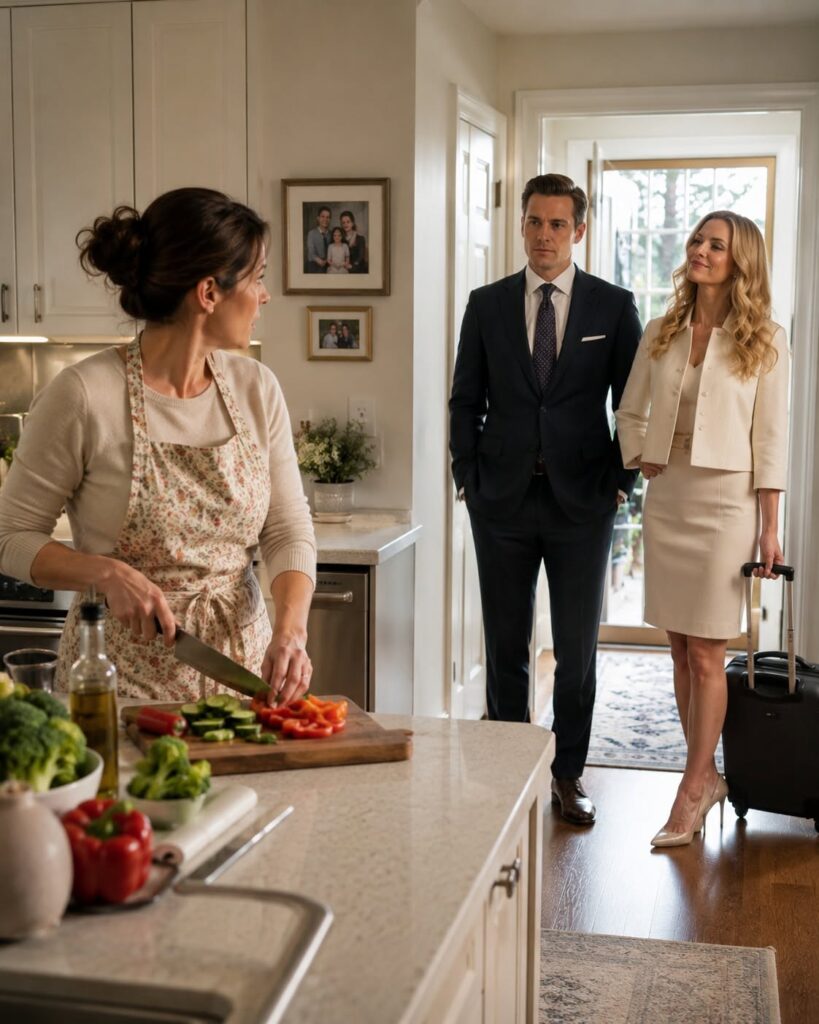

My husband invited his ex to our housewarming and …
- Stories
Cuisine And Stories
- 0
- 11 minutes read

There was laughter in every room and music low enough for conversation and nobody performing intimacy for an audience.
I spent the afternoon cooking because I like feeding people when I am not being judged for how I chop garlic. James set the table, chopped vegetables under supervision, and kept appearing at my elbow to ask if I needed anything.
At one point, I looked up from the stove and found him watching me.
“What?” I said.
He smiled in that open way of his.
“Just thinking I got lucky.”
“Syrupy.”
“True.”
During dinner, my dad told the story of how I once climbed a tree at age eight to prove I could get a kite down myself and then had to be coaxed out by three adults and half a jar of peanut butter. Everyone laughed. I groaned. Under the table, James squeezed my hand once.
Not to rescue me.
Just to be with me in the embarrassment.
Later, while we were loading plates into the dishwasher, Jenna bumped my shoulder with hers.
“You’re lighter,” she said.
“I know.”
“No, like physically. You take up space differently.”
I rinsed a plate and thought about that.
She was right.
I no longer moved through my own kitchen as if bracing for correction.
“It’s him,” she said.
I shook my head.
“Partly. But not only. He’s good to me. More importantly, I’m good to me.”
Jenna smiled.
“There she is.”
There is a version of this story people like best because it is neat.
Woman is disrespected.
Woman leaves spectacularly.
Woman later finds healthier love.
That version is satisfying because it has edges.
But the truer version includes all the messy internal work between those points. Leaving Derek did not magically restore me to factory settings. It just stopped the ongoing damage. After that, I still had to relearn how to trust my own perceptions, how to state a need before resentment made it blunt, how to distinguish the ordinary discomfort of compromise from the deadening ache of self-erasure.
There were moments with James that exposed old wiring.
Once, early on, he got quiet after a difficult phone call with his sister, and I immediately assumed I had done something wrong. I became cheerful in that brittle, overhelpful way I used to when trying to pull Derek out of moods he considered my problem.
James noticed within ten minutes.
“Hey,” he said gently. “This isn’t about you.”
“I know,” I said automatically.
He tilted his head.
“No, you don’t.”
I laughed because he was right.
Then I told him what had happened in my head, how quickly silence turned to self-blame for me. He listened, took my hand, and said, “Okay. Then let me say it clearly. I’m stressed about my sister. I’m not upset with you. You don’t need to manage me.”
Do you know what it does to a person to hear that sentence and believe it?
Around the one-year mark of my leaving Derek, I found the old notebook I had bought at the drugstore and packed into my van the day after he invited Nicole. Most of it was grocery lists, apartment measurements, stray work notes, but on one page near the front, I had written in block letters sharp enough to dent the paper:
DO NOT ARGUE YOURSELF OUT OF WHAT YOU KNOW.
I sat on the floor of the townhouse reading that line for a long time.
Then I tore the page out, framed it in a cheap black frame, and put it on the shelf in our entryway.
When James saw it, he read it once and said, “That’s excellent.”
He did not ask me to hide the evidence of my past in the name of moving on.
He simply made room for it too.
Sometimes I think about the word mature, the one Derek used like a leash.
He meant silent.
He meant compliant.
He meant absorb this without consequence so I can continue feeling good about myself.
But maturity, real maturity, has almost nothing to do with endurance for disrespect.
Real maturity is discernment.
It is recognizing patterns before they become prisons.
It is understanding that love without regard is just appetite with good branding.
It is knowing when to stay and work and when to leave because the work is all being done on one side of the wall.
I think about Nicole too, more than you might expect.
Not often.
But sometimes.
Mostly I hope she learned quickly.
There was a brief period, maybe eight months after the breakup, when she liked a photo Ava posted of a group hike I was in, which felt too indirect to be accidental and too polite to decode. I did not reach out. She did not either. But I like to imagine she remembered what I said in the apartment—not because I was especially wise, but because sometimes the truth is easier to hear from a woman on her way out than from your own instincts on the way in.
As for Derek, he became what most former partners eventually become if you survive them cleanly.
A story with useful architecture.
Not a wound.
Not a villain.
A structure I once lived inside that taught me exactly what I could not live inside again.
Every now and then, someone still asks if I regret making my exit so publicly.
“No,” I say.
And I mean it.
Not because public humiliation is inherently virtuous, but because secrecy had served him for too long. He counted on my discretion the way some people count on good credit. He believed I would preserve his image even while he challenged my dignity in front of a room full of witnesses.
Refusing that bargain was part of leaving.
The housewarming itself has become almost mythic among my friends. Marcus refers to it as “the balcony incident” with academic gravity. Jenna claims she could sell tickets to a reenactment. My mother, who heard the whole story eventually and listened with one hand over her mouth, just said, “Good,” and then asked if I had eaten that night.
My father asked whether the sink at least kept working after I left.
It did.
Sometimes on Sunday mornings, in the townhouse James and I chose together, I make coffee while he reads the paper or tinkers with one of the many absurdly specific tools he owns for bicycle maintenance. Light comes through the kitchen windows in broad warm stripes. There are two mugs in the sink. There are shoes by the door that belong to both of us. There is a framed note on the shelf reminding me not to argue myself out of what I know.
This is what partnership feels like, I think.
Not fireworks.
Not tests.
Not applause.
Just the daily luxury of being fully legible and not punished for it.
The strangest part is that if Derek had never invited Nicole, I might have stayed longer.
That is the thought that chills me most.
Not because Nicole mattered so much, but because his choice made the invisible visible. It was too blatant to soften, too public to explain away, too symmetrical with every previous discomfort to classify as isolated. In trying to force me into a performance of trust, he gave me a perfect angle from which to see the entire machine.
People like to say everything happens for a reason.
I do not believe that.
I think many things happen because people are selfish, afraid, careless, wounded, entitled, or simply not paying attention. But I do believe that once something has happened, you can decide what shape it gets to have in your life.
Derek’s ultimatum could have become one more swallowed resentment, one more compromise, one more little funeral for a piece of myself.
Instead, it became a door.
Not because walking through it was easy.
It wasn’t.
There were nights in that first winter alone when the radiator hissed and the city felt very large, and I missed the fact of companionship more than I missed him. There were holidays where answering questions about my love life felt like peeling tape off skin. There were moments with James when old fears surged and I had to resist the urge to become agreeable preemptively.
Leaving did not transport me straight to wisdom.
It simply returned me to the place where I could begin practicing it.
I still fix elevators.
I still come home with grease on my jeans and stories in my pockets.
My hands are still capable.
My laugh is louder than it used to be.
I take up more room in photographs.
Ava says my shoulders sit differently now, farther from my ears. My mother says I sound like myself again on the phone. My father, who is not sentimental unless cornered, once watched James carry a box of my winter tools into the garage without being asked and later murmured to me while slicing oranges, “This one seems to understand load-bearing structures.”
Which in my family is basically a sonnet.
Last month, James and I hosted another small gathering, just because.
No milestone.
No performance.
It rained all evening, steady and silver, and our friends tracked water onto the entryway rug while shrugging out of coats. Ava brought a roasted vegetable tart. Marcus brought a bottle of bourbon and a new story about a building manager who thought he could “just reset” a forty-year-old controller with positive thinking. Jenna brought candles and, because she cannot help herself, gossip.
Someone put music on.
Someone else opened wine.
The kitchen got crowded in the happy way kitchens should.
At one point, I stood by the sink rinsing glasses and looked out over the living room. James was on the couch listening to my father explain, with both hands, why a poorly balanced compressor is the enemy of civilization. Ava was leaning against the armchair making Naomi laugh. Jenna was stealing olives from the snack board while pretending not to. Rain streaked the windows. Light pooled gold across the room.
For one suspended second, the memory of that old apartment flashed over the scene like a double exposure.
The string lights.
The balcony.
The tightening in my ribs.
Derek’s voice telling me to be mature.
Then it passed, and all that remained was the room I was actually standing in, the room where no one needed me smaller to feel comfortable.
I dried my hands on a towel and went back to my people.
That is the ending people want, I think.
Not revenge.
Not even justice.
Just return.
The return to one’s own center after a long season of orbiting someone else’s gravity. The return to appetite, humor, instinct, noise, rest. The return to a self that recognizes the difference between being chosen and being cherished.
If I could speak to the version of me on the kitchen floor under that sink, wrench in hand, grease on her cheek, about to be told by a man in a doorway that she needed to prove her maturity by accepting humiliation, I would not say, “Don’t worry. You’ll meet someone better.”
Though eventually I did.
I would not say, “This will make a great story.”
Though eventually it did.
I would say very simply:
Listen to the stillness you feel right now. That is not weakness. That is recognition. Trust it. The part of you that goes quiet in the face of nonsense is often the part closest to truth.
Then I would tell her to tighten the pipe, text Ava, pack the watch, and leave when the time comes without apologizing for the sound of the door.
Because sometimes the thing that changes everything is not the disrespect itself.
It is the moment you stop collaborating with your own diminishment.
It is the moment you understand that calm does not mean consent, that maturity does not mean silence, that love is not measured by how well you absorb what should never have been placed on you in the first place.
That housewarming was supposed to celebrate a beginning.
In a way, it did.
Just not the one Derek had in mind.
THE END