
“My husband sneered, ‘Buy your own food. Stop living off me.’ I said nothing. Weeks later, on his birthday, 20 relatives rushed into the kitchen and then went silent. He turned pale. ‘What did you do?’ I smiled. ‘Exactly what you told me to.’”
- Stories
Cuisine And Stories
- 0
- 16 minutes read

Chapter 5: The Geography of an Empty Oven
The embarrassment in the room was a palpable, suffocating fog. Megan, the older sister, tried to laugh it off, a brittle, staccato sound.
“Oh, I get it! It’s a joke, right? A birthday prank?” she said, her eyes pleading with me to produce a hidden ham from a cupboard.
“No joke, Megan,” I said gently. “Rules are rules. Mark was very clear about our new financial arrangement. I am responsible for my sustenance, and he is responsible for his.”
Sondra turned to her son, her face flushing a deep, mottled red. “Mark? What is she talking about? Did you tell your wife not to buy food for the house?”
Mark looked like he wanted the floor to open and swallow him whole. His birthday had been transformed from a celebration of his existence into a public audit of his character. He opened his mouth to speak, but no words came out. What could he say? ‘Yes, I insulted her in our kitchen and told her she was a parasite, but I still expected her to cook me a five-course meal?’
He looked at me, and for the first time in years, he really saw me. He saw the woman who had meticulously cleaned the house but left the fridge empty. He saw the tactical precision of my strike. He saw that I wasn’t hurt anymore; I was finished.
“I’ll… I’ll order something,” he stammered, his voice small and hollow. “I’ll get some catering platters from the deli. They’re open late.”
“Good idea, son,” Sondra snapped, her voice like a whip. “Since it seems you’ve forgotten how a household works.”
The relatives retreated from the kitchen, their whispers like the dry rustle of leaves. They moved back into the living room, but the energy was ruined. The “Perfect Husband” facade had been stripped away, leaving behind a man frantically scrolling through a delivery app on his phone.
I stayed in the kitchen. I picked up my yogurt. I opened it and began to eat, slowly and deliberately.
About an hour later, the food arrived. It was the efficient, soul-less bounty of a commercial deli—plastic trays of cold cuts, pre-made salads in translucent tubs, and rolls that felt like sponges. It wasn’t the feast they were used to. It was a “fix.”
I watched from the shadows as they ate. They were quiet now, the exuberant laughter replaced by a careful, hushed conversation. They looked at me with a mixture of fear and newfound respect. They realized that the quiet woman in the corner wasn’t a piece of furniture. She was the architect of the house, and she had just revoked their access.
After the last guest had shuffled out the door, the house settled into a silence that was different from the one before. It wasn’t the silence of peace. It was the silence of a demilitarized zone.
Chapter 6: The Inventory of Tomorrow
I spent the evening cleaning the kitchen for the second time that day. I moved with a slow, meditative rhythm. I wiped down the counters where the deli trays had sat. I put the empty plates in the dishwasher.
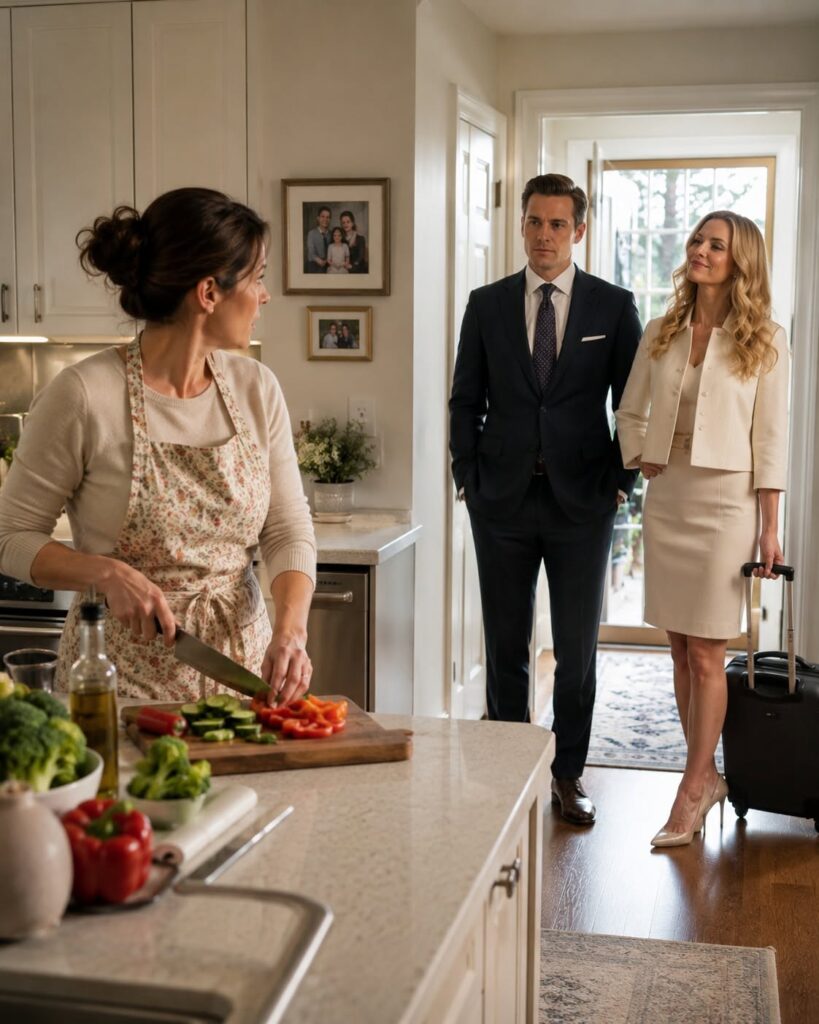
Mark came into the room as I was finishing. He didn’t come to the island. He stayed by the doorway, the very spot I had occupied during the party. He looked exhausted, the weight of the evening having aged him a decade in five hours.
He looked at the fridge. Then he looked at me.
“That was cruel,” he said. His voice was flat, lacking the casual edge it had possessed weeks ago.
“No, Mark,” I said, leaning against the sink. “It was honest. Cruelty is telling your partner they are a burden while they are working to make your life beautiful. Honesty is showing you what that burden actually looks like when it’s gone.”
He didn’t have a rebuttal. The logic was too clean, too iron-clad. He looked at the pantry—at my small, labeled shelf.
“I ordered a grocery delivery for tomorrow morning,” he said quietly. “A big one. Everything we usually have. Steaks, the rice you like, the good coffee.”
“That’s a start,” I said.
“And… I’m sorry. For what I said that night. I was stressed. I wasn’t thinking.”
“You were thinking exactly what you felt, Mark. You just didn’t think I’d take you at your word.”
I walked past him toward the stairs. I felt light. The weight of the domestic expectation I had carried for years had been transferred to him, and I had no intention of taking it back.
“Are you coming to bed?” he asked.
“In a bit,” I said. “I have some things to finish.”
The next morning, the house smelled of a different kind of quiet. I heard the delivery truck pull into the driveway at 7:00 AM. I heard Mark moving in the kitchen, the heavy thud of grocery bags being set on the counter. I heard the rustle of plastic as he began to put things away.
I stayed in bed, listening.
When I finally went downstairs, the kitchen looked “normal” again. The fridge was full. The pantry was stocked. The “shared” items had returned to their rightful places.
But as I reached for the milk to make my coffee, I noticed something. He had put the new gallon on my shelf. Next to my yogurt.
I took out my permanent marker. I didn’t cross out my name. I simply drew a line under it.
We didn’t have a grand conversation about rules or responsibilities. We didn’t sign a contract. But the geography of our marriage had changed. He still bought the food, and I still bought mine. But now, when he looked at a full fridge, he didn’t see a divine right. He saw the labor of a woman who knew exactly how to leave him hungry.
I sat at the island, sipping my coffee. The sun was coming up, hitting the lilies in the living room. They were starting to wilt, their time of performance over. I didn’t replace them.
Epilogue: The New Normal
It has been six months since the night of the empty kitchen.
On the surface, things look remarkably like they did before. We still share a house. We still attend family functions. But the internal clockwork of the relationship has been dismantled and rebuilt with more resilient parts.
Mark pays for the groceries now. All of them. He does the shopping on Sunday mornings. He handles the meal planning. He has learned the specific, grueling science of anticipating what a household needs to survive.
I still buy my own treats. I still keep my labeled shelf in the pantry. It’s not because I’m being “petty.” It’s because that shelf is a monument. It is a reminder of the night I stopped being a ghost and became a person.
He is different now. He doesn’t pat my shoulder. He doesn’t talk about “living off him.” He treats me with a careful, almost formal respect—the kind of respect one gives to a powerful neighbor whose borders you have learned not to cross.
Last night, we were in the kitchen again. The late evening kind. He was making a salad, and he realized he was out of dressing.
He looked at the fridge, then at me.
“Elena?” he asked. His voice was hesitant. “Can I… can I use some of your vinaigrette? The one you bought yesterday?”
I looked at him for a long moment. I thought about the casual dismissal of that rainy October night. I thought about the empty plates on the island. Then I looked at the man who was finally learning how to ask.
“Yes, Mark,” I said, sliding the bottle toward him. “You can have some.”
But I didn’t take the label off.
Cliffhanger: The Letter in the Drawer
The peace we have built is a fragile thing, a house of cards held together by careful silence. But this morning, while Mark was at work, I was looking for a stamp in the desk in the den—the desk he told me never to touch.
Tucked behind a stack of old bank statements, I found an envelope. It was from a law firm, dated three weeks ago.
I opened it, my heart beginning to thud with a familiar, cold rhythm.
Inside was a draft for a legal separation, meticulously detailed, and a list of assets that had been “protected” over the last six months—accounts I didn’t know existed, property in his mother’s name that had been purchased with our shared savings.
I looked at the kitchen, where the fridge was full of food he had bought to show me he had changed.
He hadn’t been learning how to provid for me. He had been learning how to provide for himself… after I was gone.
I picked up my permanent marker from the counter. I didn’t write on a jar of jam. I walked back to the desk, and on the front of the legal document, in my beautiful, precise script, I wrote a single word:
Elena’s.
The game wasn’t over. It was just entering the second half.
The End.