
She Wore My Secret Gown to Fashion Week. By Midnight, I Owned the Scandal.
- Stories
Cuisine And Stories
- 0
- 12 minutes read
“She recorded your words.”
“She pushed me.”
“She did not invent your voice.”
“I was telling her what she wanted to hear.”
“You told her my grief made the timing perfect.”
He went still.
Rachel’s evidence had not yet been disclosed to him.
“How do you know that?”
“I know everything now.”
For a second, he looked toward the doors.
He seemed to understand that the hotel, the ballroom, the company, the evidence, and the silence itself no longer belonged to him.
“I never wanted to hurt you,” he said.
“You wanted to remove me.”
“I thought you would recover.”
“From what?”
“From losing the company.”
He heard the cruelty only after it left his mouth.
I nodded slowly.
“That is what you believed I would survive.”
“Vivian.”
“But you could not survive being known as my husband.”
His expression broke.
Not because I had insulted him.
Because I had named him correctly.
He reached for me.
I stepped back.
“I can fix this,” he said.
“No.”
“We can withdraw the divorce.”
“No.”
“I will repay the money.”
“Yes, you will.”
“I will make a public statement.”
“You have already made enough.”
His voice lowered.
“Did you ever love me?”
The question was selfish, but the answer was not.
“Yes.”
My throat tightened.
“I loved you enough to trust you beside everything I built.”
“Then how can you walk away this easily?”
I looked at the empty runway where he had planned my destruction.
“This is not easy.”
I let him see the pain in my face.
“It is simply final.”
PART 5 — THE WOMAN WHO OWNED THE ENDING
The rescheduled show began twenty-four hours later.
The guest list doubled.
Every editor who had attended the first night returned, joined by buyers, artists, founders, and women who had spent the day sharing my words.
The Halcyon ballroom looked different.
The gold entrance arch had been removed.
The press line was smaller.
The runway remained bare except for a single white orchid placed at the entrance.
I wore a black satin dress with a square neckline and long sleeves.
My dark hair was pulled into a low knot, revealing the clean lines of my youthful face and the small diamond studs my mother had given me when I turned twenty-one.
There was no wedding ring on my hand.
At 9:09, the lights dimmed.
The collection began again.
This time, no one whispered about Bennett.
No one watched the door for Ava.
The clothes held the room by themselves.
Black coats moved beneath white light.
Pearl-gray silk floated across the runway.
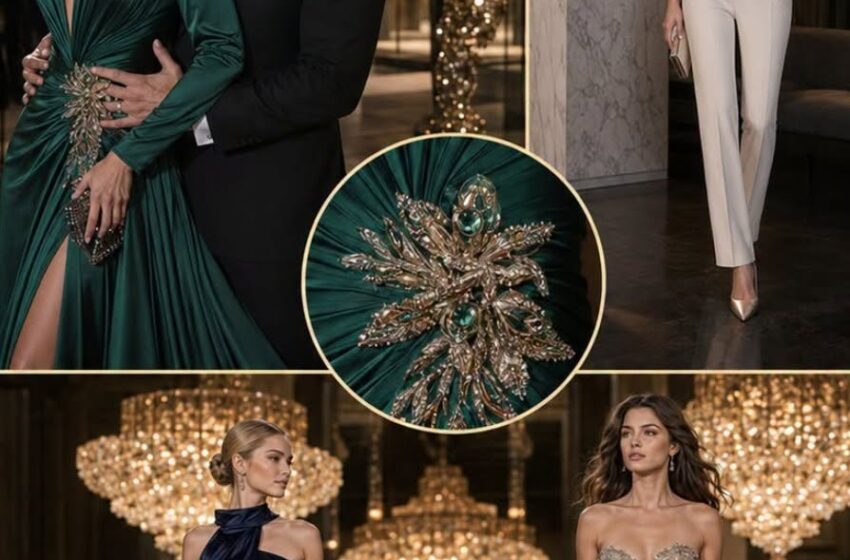
Crystal embroidery glimmered like ice.
Backstage, Lena monitored every cue.
Naomi watched from the front row.
Rachel sat beside the other women from our operations team.
The final violin note began at 9:17.
For one breath, the entrance remained empty.
Then Winter Orchid appeared.
We had worked through the night to repair it.
The torn organza had been replaced.
Every missing crystal had been reset by hand.
But I asked the atelier to make one change.
Inside the train, beneath layers invisible to the audience, the seamstresses embroidered nine names in silver thread.
My mother’s.
Mine.
And the seven women who had restored the gown after it was stolen.
The model stepped into the light.
The audience rose before she reached the center.
Winter Orchid opened behind her in a sweep of silver-white silk.
The crystals caught the light, not like something fragile, but like something sharpened by pressure.
I stood behind the curtain and watched the gown complete the walk it had been denied.
My mother used to say damaged fabric should never be disguised.
A skilled seamstress did not pretend the tear had never happened.
She reinforced the place where it had weakened so the garment would never break there again.
When the model reached the end, she turned.
The train settled.
The ballroom became quiet.
Then she extended her hand toward me.
That was not part of the rehearsal.
I looked at Lena.
She was smiling through tears.
“Go,” she whispered.
I stepped onto the runway.
The applause struck like weather.
For years, I had sent my work into the light while remaining behind the curtain.
That night, I walked beside it.
Not as Bennett’s abandoned wife.
Not as the woman who had been humiliated.
Not as a viral clip.
I walked as the designer, the founder, the employer, the daughter, and the owner of the name stitched into every label.
At the end of the runway, I faced the audience.
“My mother taught me to sew when I was six,” I said.
“She also taught me that beautiful things are not delicate simply because they are beautiful.”
The room quieted.
“Winter Orchid was damaged last night.”
I touched the edge of the train.
“It has been repaired by the same women who created it.”
The seamstresses stepped from backstage.
“Beginning this year, Vesper Row will establish the Celeste Hart Fellowship for young designers and garment workers who cannot afford formal training.”
Applause rose again.
“The fellowship will be funded by profits from the Winter Orchid collection and by all financial recoveries connected to the misuse of company assets.”
Naomi’s smile was small and satisfied.
The audience understood.
Every dollar Bennett repaid would help create the future he had tried to steal.
After the show, I returned to the atelier.
The worktables were covered with flowers.
Handwritten notes arrived from across the country.
Some came from designers.
Some came from wives.
Some came from women who had been told they were too emotional to lead companies they had built.
One note was written on the back of a grocery receipt.
He took my confidence, but your story reminded me that he did not own it.
I placed it inside my desk.
At midnight, Naomi called with an update.
Bennett had agreed to surrender his remaining claims under the prenuptial agreement.
The agreement did not punish infidelity by itself.
It protected separate property and required repayment for marital funds spent on an affair or concealed misconduct.
Because he had used company and marital assets to finance his relationship with Ava, he faced both corporate and personal recovery claims.
He chose settlement over discovery.
The penthouse remained mine.
The company remained mine.
The trademarks, archive, patents, and hotel interest remained within Celeste Holdings.
Bennett retained his personal savings, a small apartment he had purchased before our marriage, and whatever reputation he could rebuild without using my name.
He was not left penniless.
He was left proportional.
For a man who had mistaken luxury for identity, that felt worse.
Ava reached her own settlement months later.
She returned every Vesper Row item in her possession, paid damages through her insurance and future campaign earnings, and issued a carefully worded admission that she had worn Winter Orchid despite knowing it had not been authorized by the designer.
I did not ask for an apology.
An apology delivered through attorneys was simply another document.
The public moved on faster than pain did.
New scandals arrived.
New faces filled the feeds.
The phrase I needed you to say that on camera remained popular for a while, printed on coffee cups, captions, and shirts I never licensed.
But eventually, the internet found another woman to celebrate and another man to condemn.
I was grateful.
Virality was useful, but it was not a home.
My real life returned in quieter pieces.
Morning fittings.
Budget meetings.
Coffee with Lena.
Long walks through Central Park without checking whether photographers followed.
Therapy on Thursday afternoons.
Dinner with my aunt in Connecticut.
The first night I slept eight hours without dreaming about the ballroom.
Six months after the show, I visited my mother’s old bridal shop.
Celeste Holdings had preserved the building, though I had not entered it since her funeral.
Dust covered the front windows.
A measuring tape remained looped around a brass hook near the cutting table.
On the wall, faint pencil marks recorded my height from childhood.
Age eight.
Age eleven.
Age fifteen.
At twenty-seven, I stood beneath them wearing shoes my mother would have called unnecessarily expensive.
I could almost hear her laughing.
The fellowship’s first students were scheduled to arrive the following week.
We had renovated the upstairs rooms into classrooms and installed new sewing machines beside the old wooden tables.
I walked through the building alone until I reached the rear workroom.
That was where I had made my first dress.
It had been crooked, blue, and far too ambitious.
My mother had examined it for several minutes before saying, “The fabric always tells you where you forced it.”
At the time, I thought she was speaking about seams.
Now I understood she had been speaking about everything.
Marriage.
Business.
Grief.
Power.
A life could be pulled into a shape it did not want, but strain always left evidence.
The answer was not to hide the evidence.
The answer was to stop forcing the shape.
I opened the shop windows.
Late-afternoon sunlight entered the room.
For the first time in years, the space did not feel haunted.
It felt ready.
CONCLUSION — WHAT SURVIVED THE WINTER
On the first day of the Celeste Hart Fellowship, twelve young women gathered around my mother’s cutting table.
Some had never used an industrial sewing machine.
One had traveled from Oklahoma.
Another had worked two jobs in Queens while teaching herself patternmaking through library books and online videos.
I looked at their hopeful faces and remembered the girl I had been at twenty-two, stitching samples after midnight while Bennett packed boxes beside me.
I did not rewrite that memory.
He had been kind then.
I had been happy then.
A betrayal at the end did not require me to poison every good moment that came before it.
It only required me to stop using old love as evidence that new harm should be forgiven.
I taught the students how to cut silk on the bias.
Lena taught them production planning.
Rachel joined Vesper Row’s compliance team and designed a mentorship program for young employees entering executive environments.
Naomi visited once and frightened everyone until she took off her jacket and showed them how badly she sewed.
The room filled with laughter.
In the front window, we placed a single white orchid.
Beneath it was a small silver plaque.
Beautiful things are not weak.
They simply deserve hands that know how to hold them.
A year after the scandal, Winter Orchid entered the permanent Vesper Row archive.
We displayed it only once, at the fellowship’s anniversary dinner.
Guests gathered around the glass case and searched for signs of damage.
Most could not find them.
I could.
I knew where the organza had torn.
I knew where the crystals had been replaced.
I knew every hidden stitch.
The gown was not valuable because it had escaped ruin.
It was valuable because skilled hands had restored it without pretending it had never been harmed.
That night, I stood alone beside the case after the guests left.
My reflection appeared faintly in the glass.
I was twenty-eight now, still young, still soft-faced, still capable of trusting people despite everything that had happened.
For a long time, I had feared betrayal would harden me into someone unrecognizable.
It did not.
It made me precise.
I no longer confused forgiveness with access.
I no longer confused silence with peace.
I no longer allowed anyone to stand beside my work while quietly teaching me to feel grateful for my own success.
Outside, snow began falling over Manhattan.
The flakes disappeared against the hotel windows, small and bright beneath the city lights.
I thought about Bennett only briefly.
He had moved to another state and joined a consulting firm that did not place his photograph on its website.
I heard he told people we had wanted different things.
That was true.
I had wanted a partner.
He had wanted an inheritance from a living woman.
I turned off the gallery lights.
Winter Orchid vanished into darkness, safe behind glass.
Then I walked downstairs, where my team was waiting with champagne, cake, and twelve fellowship students arguing happily over which of them had broken the zipper on the practice gown.
Lena handed me a glass.
“To ownership,” she said.
I smiled.
“To repair.”
We raised our glasses.
The room was warm.
The people inside it knew my name, but more importantly, they knew their own.
I had once believed revenge would feel like watching Bennett lose everything.
It did not.
Revenge was too small a word for what came after him.
The real victory was that the doors still opened in the morning.
The needles still moved.
The women were still paid.
The dresses still entered the light.
And when the world remembered the night my husband gave his mistress my finale, it no longer remembered me as the wife standing backstage.
It remembered that I owned the stage.
ENDING LINE
He thought he had stolen my dress, my company, and my ending.
All he stole was the last chance I would ever give him.
CAPTION
She stole the finale before the runway began, but his wife owned the gown, the company, the hotel, and the ending.Preview
See more on the next page