
The groom tore my wedding dress to throw me out, but forty-seven black vehicles arrived because I had already removed him from everything he thought he owned..
- Stories
Cuisine And Stories
- 0
- 16 minutes read
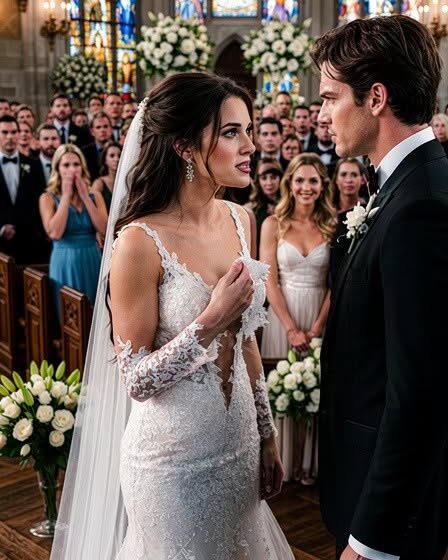
I met his eyes.
“You told me to get out.”
His throat moved.
“I was angry.”
“You ripped my wedding gown open in front of three hundred people.”
His face flushed.
“You knew Camille was fragile about weddings. You knew what happened to her mother—”
Camille gasped theatrically.
There it was again.
The sacred shield.
Camille’s trauma.
For three years, every cruelty she committed arrived wrapped in explanation. Camille controlled holiday dinners because “family transitions were hard for her.” Camille excluded me from planning meetings because “she had abandonment anxiety.” Camille borrowed my jewelry and did not return it because “she was attached to beautiful things after losing so much.”
And now, apparently, Camille could watch my fiancé tear apart my dress because seeing me in white injured her.
I looked at her.
“Your mother didn’t die at a wedding, Camille.”
The chapel went silent.
Camille froze.
Julian’s eyes widened.
“What?”
I did not look away from her.
“She left.”
Camille’s face lost all expression.
“Stop.”
I continued, because some truths must be spoken exactly where lies have been worshipped.
“She left your father after discovering he had been using her inheritance to cover Cross family debts. She filed for divorce in London. She was alive for six years after that.”
Julian turned slowly toward Camille.
“That’s not true.”
Camille whispered, “Celia.”
Not commanding.
Begging.
For the first time since I had known her, Camille looked frightened in a way that did not feel rehearsed.
Mr. Vale handed me a thin folder.
I held it but did not open it.
“Your mother wrote to you,” I said. “Twice a year. The letters were intercepted.”
Camille shook her head.
“No.”
Julian’s voice sharpened.
“Who intercepted them?”
I looked at him.
“Your father.”
A sound moved through the chapel.
Julian’s father, Maxwell Cross, sat in the front row with his cane resting against one knee. Until that moment, he had watched the proceedings with the cold stillness of old wealth under attack. He was seventy, broad-shouldered despite age, with silver hair and a mouth that seemed permanently shaped around disapproval.
Now every eye turned toward him.
Maxwell did not flinch.
He looked at me and smiled faintly.
“You have been busy.”
The smile chilled me.
“I learned from the best,” I said.
His eyes glittered.
“No, Miss Ellison. If you had learned from the best, you would not be doing this in public.”
I looked at the rows of guests, the raised phones, the witnesses who had finally become useful.
“That was Julian’s choice.”
Julian flinched.
Mr. Vale stepped forward.
“Mr. Cross, you are named in multiple filings concerning trust fraud, wrongful diversion of preservation funds, and coercive interference with correspondence belonging to a minor under your guardianship.”
Maxwell’s expression did not change.
“You sound theatrical, Adrian.”
“You sound familiar,” Mr. Vale replied.
That gave Maxwell pause.
The air between the two old men tightened.
They knew each other.
Of course they did.
Men like them always did.
Camille looked at Maxwell, trembling.
“You told me she died.”
Maxwell turned toward her, and for one second, I saw something almost paternal cross his face.
Then it vanished.
“She abandoned you.”
“No,” I said.
Maxwell’s gaze snapped back to me.
“She was kept from her.”
Camille’s fingers rose to her mouth.
“No,” she whispered. “No, no, no.”
Julian looked between Camille and his father.
“Dad?”
Maxwell’s voice hardened.
“Control your fiancée.”
The words were automatic.
Not ex-fiancée.
Not Celia.
Your fiancée.
Still spoken as if I belonged to Julian’s management.
I laughed once.
The sound startled the chapel.
“I think that role expired when he shredded the contract’s dress code.”
Someone near the back choked.
Even Mr. Vale’s mouth twitched.
Julian’s face darkened.
“You think this is funny?”
“No,” I said. “I think it is the first honest thing this family has ever given me.”
He stepped closer.
Elias—Mr. Vale’s head of security—moved between us instantly.
Julian stopped.
The crowd noticed that too.
The groom barred from approaching the bride.
My ruined gown suddenly seemed less like humiliation and more like evidence.
Mr. Vale’s team began setting document boxes along the side aisle. The federal investigators stood near the chapel doors, speaking quietly with local authorities who had just arrived in dark uniforms. Guests who had once looked amused now looked trapped.
Good.
Let them feel the room shift.
Let them understand how quickly entertainment becomes testimony.
Camille sank back into the front pew, shaking. For the first time, I wondered how much of her cruelty was strategy and how much was grief trained into a weapon by people who benefited from her need to be chosen.
It did not excuse her.
But it changed the edges.
Julian’s voice dropped.
“Celia, listen to me.”
I turned back to him.
“No.”
He blinked.
“I said listen.”
“And I said no.”
The word held.
His face tightened.
I took one step toward him—not close enough to be touched, close enough that he could not pretend I was speaking from safety.
“For years, I listened. I listened when you said Camille needed patience. I listened when you said the estate needed temporary support. I listened when you said your father’s debts were old family complications. I listened when you said not to worry about revised trust language because your attorney was only making our future easier.”
My voice shook now.
Not from fear.
From finally letting the truth move through me.
“I listened when you told me love meant trust. What you meant was silence.”
Julian’s expression flickered.
Just once.
There was guilt there.
Buried.
Quickly covered.
“I loved you,” he said.
The chapel went painfully quiet.
Those words still had a door into me.
Some part of me saw him as he had been—or as I had believed him to be. Laughing in a bookstore aisle because I mispronounced an author’s name. Holding my hand through the anniversary of my parents’ death. Dancing with me barefoot in his kitchen when the power went out during a storm.
I wanted that man to be real.
Maybe he had been.
But not real enough.
“No,” I whispered. “You loved what loving me could solve.”
His face tightened.
“That’s cruel.”
“So was ripping my dress.”
He looked down.
The strip of lace still lay near his shoes.
An usher, poor man, had been standing beside the chapel door all this time, visibly unsure whether to intervene, pray, or resign. He stared at the lace as if it were a body.
Mr. Vale cleared his throat.
“There is one more matter.”
Maxwell’s head lifted.
His eyes narrowed.
“No.”
Mr. Vale did not look at him.
“Miss Ellison, would you like me to continue?”
Every part of me wanted the day to end.
I wanted to walk out of the chapel, wash the humiliation from my skin, burn every white flower, and sleep for a year.
But Maxwell Cross had said no.
That meant the truth was necessary.
“Yes,” I said.
Mr. Vale accepted another folder from Miriam, one of his senior associates.
“This morning, before the ceremony, we received confirmation that the proposed marital trust amendment delivered by Cross family counsel contained an unauthorized annex.”
Julian’s face changed.
Subtly.
But enough.
I turned toward him.
“You told me the amendment only updated beneficiary language.”
He said nothing.
Mr. Vale continued, “The annex would have granted Julian Cross emergency voting proxy over Ellison Foundation assets in the event that Miss Ellison became incapacitated, emotionally compromised, pregnant, medically unavailable, or subject to marital dispute.”
The chapel exploded.
Pregnant?
Medically unavailable?
Marital dispute?
I could barely hear over the roar of blood in my ears.
I stared at Julian.
“You were planning to declare me unstable.”
His jaw tightened.
“No. It was legal protection.”
“For whom?”
“For us.”
“There is no us in a document that makes my grief, body, and anger into reasons you can take control.”
He looked at Maxwell.
Again.
That old reflex.
The son searching for permission from the father.
Maxwell did not rescue him.
That was answer enough.
I turned on Maxwell.
“You wrote it.”
He lifted one shoulder.
“My attorneys drafted a prudent clause.”
“Prudent.”
“Yes,” he said. “You are emotional, as this spectacle proves.”
I smiled.
It must have looked strange beneath my torn veil.
“Thank you.”
His eyes narrowed.
“For what?”
“For saying the quiet part into three hundred cameras.”
Several guests immediately looked at their phones.
Maxwell’s mouth tightened.
For the first time, he seemed irritated at the audience.
Julian whispered, “Dad, stop.”
Maxwell ignored him.
His gaze remained on me.
“You are making an enemy of a family that knows how to endure.”
“No,” I said. “I am ending my usefulness to a family that knows how to consume.”
The doors opened again.
A woman stepped into the chapel.
She was older, perhaps in her late fifties, wearing a dark green coat, hair streaked with gray and pinned loosely at the back of her neck. She walked with a slight limp, one hand resting on the arm of a younger woman beside her.
Camille stood so abruptly she almost fell.
The entire chapel seemed to inhale.
The woman looked at Camille.
Her face crumpled.
“Millie,” she whispered.
Camille made a sound like her heart had broken through her throat.
“Mom?”
The word tore through every defense she had left.
She stumbled into the aisle.
The woman stepped forward, crying now.
Camille stopped halfway, shaking so violently the younger woman supporting her mother moved as if to help.
“No,” Camille whispered. “You’re dead.”
Her mother shook her head.
“No, baby.”
Camille looked at Maxwell.
“You said she was dead.”
Maxwell’s face had gone hard as marble.
“I said she was dead to us.”
The cruelty of it silenced the chapel.
Camille turned back to her mother.
Her name was Elise Doran. I knew because I had spent three weeks searching court archives, six days tracking sealed correspondence, and one sleepless night reading letters she had written to a daughter who never received them.
Elise extended a trembling hand.
Camille looked at it as if reaching for it might undo her entire life.
Then she stepped forward and collapsed into her mother’s arms.
The sound she made was not elegant.
It was not sweet.
It was a child’s sob trapped inside a woman’s body for twenty years.
Elise held her fiercely.
“I wrote,” she cried. “I wrote every birthday. Every Christmas. I tried to come back.”
Camille sobbed harder.
“I thought you left me.”
“I never left you. They kept you from me.”
Julian stared at them, face ashen.
Something shifted in him then.
Not enough to save him.
But enough to hurt.
He looked at Maxwell.
“You told us she died.”
Maxwell’s expression remained cold.
“She chose money over family.”
Elise lifted her head from Camille’s shoulder.
“You stole my inheritance to cover your shipping losses. Then you threatened to accuse me of kidnapping if I tried to take my daughter.”
Maxwell’s mouth twisted.
“Your inheritance saved this family.”
“No,” Elise said. “It fed your pride.”
Camille pulled back, tears streaming, mascara ruined.
She looked at me.
For one moment, I saw every horrible thing she had done to me pass through her eyes—the sabotaged fittings, the whispered insults, the way she manipulated Julian’s guilt, the smile when he tore my dress.
Her voice broke.
“You knew?”
I nodded.
“Since yesterday.”
She flinched.
“Why didn’t you tell me before the wedding?”
The question was not accusation exactly.
It was pain looking for a target.
“Because I didn’t know if you would believe me,” I said honestly. “And because Mr. Vale advised waiting until your mother could be here safely.”
Camille looked down.
“I was cruel to you.”
“Yes.”
“I thought…” She swallowed. “I thought if Julian chose you, I disappeared.”
Elise made a small grieving sound.
Camille looked back at me.
“That doesn’t excuse it.”
“No,” I said. “It doesn’t.”
The answer seemed to steady her more than forgiveness would have.
She nodded once, crying silently.
Julian stood utterly still.
He looked at Camille, then at me, then at his father.
“I didn’t know,” he said.
I believed him about that.
Not the money.
Not the trust amendment.
Not the strategy.
But Elise Doran? Her being alive?
He had not known.
“You knew enough,” I said.
The words landed between us.
His eyes closed briefly.
“Yes.”
It was the first honest thing he had said all day.
Mr. Vale moved closer to me.
“Miss Ellison, local officers are ready to take statements.”
Maxwell laughed softly.
Everyone turned.
He remained seated in the front pew, one hand over the silver head of his cane, looking almost amused now. He had watched his son unravel, his foster daughter reunite with a mother he had erased, his estate seized, his legal structure exposed, and yet something in him had settled into cold certainty.
“You all think this ends in a chapel,” he said.
Mr. Vale’s eyes narrowed.
“No,” Maxwell continued. “It began long before any of you understood the board you were standing on.”
I felt the air change.
Mr. Vale stiffened.
Maxwell looked at him.
“You never told her, Adrian?”
My pulse quickened.
Mr. Vale’s face did not change, but his silence did.
I turned toward him.
“Told me what?”
Maxwell smiled.
“There it is. The old guardian still deciding which truths the little heiress can survive.”
Mr. Vale’s expression hardened.
“Maxwell.”
“No, no. You opened my family in public. Let us be generous.”
I felt the torn lace in my hands tighten.
“What is he talking about?”
Mr. Vale looked at me.
For the first time since he entered, he seemed old.
“Celia.”
The way he said my name frightened me.
Maxwell leaned back.
“Ask him why your parents were flying to Newport the night they died.”
The chapel disappeared.
My parents’ plane crash had been the defining absence of my life. A sudden storm over the coast. Mechanical failure. No survivors. I was nineteen, studying abroad, and by the time I came home, the world had already made decisions around my grief.
I looked at Mr. Vale.
“They were coming home from Boston.”
“No,” Maxwell said. “They were coming here.”
Mr. Vale closed his eyes.
My heart pounded.
“Why?”
Maxwell’s smile widened.
“To sign the original Cross-Ellison settlement.”
A murmur spread.
Cross-Ellison.
I had never heard those names joined before.
Mr. Vale turned toward Maxwell.
“Enough.”
But Maxwell’s eyes stayed on me.
“Your father discovered the truth about the estate debt, yes. But more importantly, he discovered what the Cross family had been holding beneath the chapel since the 1940s.”
Mr. Vale stepped forward.
“Maxwell, do not.”
That confirmed it.
Whatever this was, Mr. Vale knew.
I looked at him, hurt rising so fast I almost lost balance.
“You knew something about my parents’ deaths?”
Mr. Vale turned to me.
“I knew what they were investigating.”
“And you never told me?”
“I was trying to protect you.”
The phrase landed like a curse.
I laughed once, broken.
“Everyone has been protecting me all my life. It’s amazing I know anything at all.”
He flinched.
Good.
Maxwell’s voice lowered.
“They died because your father wanted what was never his.”
I turned on him.
“My father?”
“Yes. Your noble father. Your sainted Ellison Foundation patriarch. He wanted the chapel vault opened.”
“The what?”
Maxwell’s smile faded.
For the first time, he looked not triumphant, but afraid of his own next words.
“The vault under St. Bartholomew’s.”
The chapel itself seemed to react.
A sound moved beneath the floor.
Low.
Mechanical.
Ancient.
Everyone froze.
Mr. Vale looked sharply toward the altar.
So did Maxwell.
The floral arch trembled slightly.
I felt the vibration through the soles of the borrowed shoes.
“What is happening?” Camille whispered.
Mr. Vale’s phone buzzed.
Then mine.
Then Julian’s.
Then every phone in the chapel.
A simultaneous notification.
Unknown sender.
A video file.
No one moved.
I opened mine.
The screen showed a dim room lined in stone. A woman sat at a desk, older, pale, but with my eyes.
My mother.
My dead mother.
The chapel tilted.
I gripped the pew beside me.
“No,” I whispered.
The woman on the video looked directly into the camera.
“Celia, if you are seeing this, then Maxwell Cross forced the wedding crisis before Adrian could open the vault safely.”
Mr. Vale made a broken sound.
My mother continued.
“You were told your father and I died in a plane crash. That is only partly true.”
My breath stopped.
Beside me, Julian whispered, “What?”
“My husband died that night,” my mother said, voice trembling. “I survived long enough to be hidden. Adrian helped me disappear because the Cross family and the Ellison board both wanted the same thing buried beneath St. Bartholomew’s.”
I turned slowly toward Mr. Vale.
Tears filled his eyes.
“I’m sorry,” he whispered.
The video continued.
“The vault contains the original Ellison-Cross charter and the proof that the estate, the chapel, and the foundation were built on stolen medical patents belonging to Elise Doran’s family.”
Elise gasped.
Camille clutched her mother.
Maxwell stood abruptly.
“That’s enough!”
But the video played on.
My mother leaned closer.
“Part Three begins under the chapel floor. Celia, do not trust Maxwell. Do not trust the Ellison board. And do not open the vault with Julian unless you are prepared to learn why your parents arranged this marriage before you ever met him.”
My stomach turned.
Arranged this marriage?
Julian stared at me in horror.
Then the floor beneath the altar split with a deep stone groan.
The aisle trembled.
Flowers fell.
Guests screamed.
A hidden staircase began to emerge from beneath the very place where I had almost said my vows.
And from the darkness below came a voice over the chapel speakers.
A woman’s voice.
My mother’s voice.
Alive.
“Celia,” she said, “bring Julian down with you. He is not just the groom who betrayed you—he is the second key.”