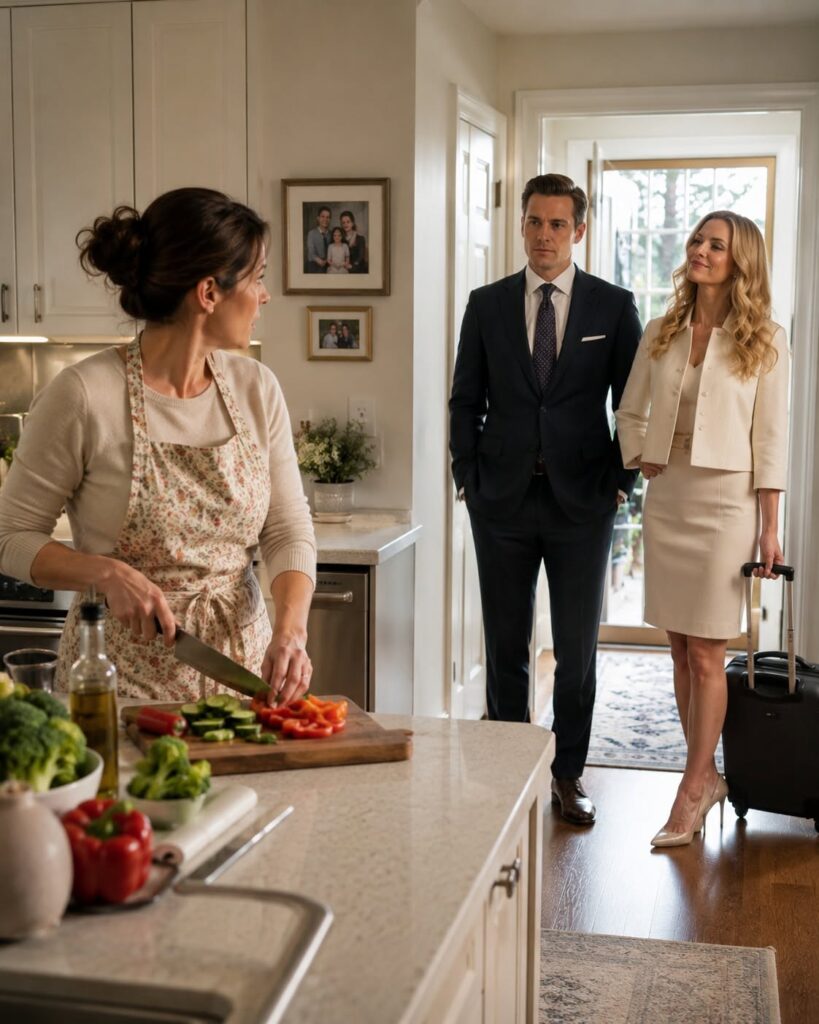

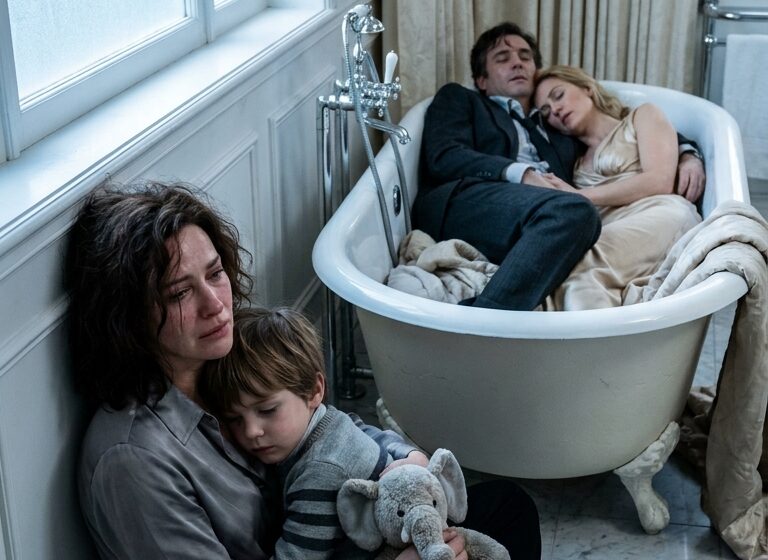
When I got home at 6 a.m., my husband was asleep with my sister in the guest room—while my son lay cold and alone on the kitchen floor, holding his stuffed elephant. I picked him up and left. Then his world fell apart.
- Stories
Cuisine And Stories
- 0
- 17 minutes read
Chapter 3: The Bleeding Ledger
Noah slept through the brief drive. I navigated to the Marriott on Clement Avenue, checking in under my maiden name and my LLC, a contingency protocol Patricia and I had mapped out in her mahogany-paneled office months ago.
We entered the sterile suite. I laid my son on the crisp white sheets, pulling the heavy blackout curtains tight against the rising sun. I sat on the edge of the mattress, my posture rigid, waiting for the phone to vibrate.
When Patricia called back, she delivered the autopsy report of my marriage.
“The bleeds aren’t minor anymore,” she said, her voice dropping an octave. “My forensic accountant spent the night digging through the secondary ledgers. Over the past fourteen months, Marcus has siphoned exactly sixty-three thousand dollars out of your shared assets.”
I stopped breathing. “Sixty-three?”
“He was methodical,” Patricia continued relentlessly. “Moving amounts just beneath the threshold of banking fraud alerts. A portion of it fed a secret credit line in his name. A larger chunk disappeared into untraceable cash ATM withdrawals. But the worst of it… seventeen thousand dollars was wired from Noah’s 529 education fund.”
I gripped the bedsheet, my knuckles turning white. “Where did the education money go, Patricia?”
“It secured the down payment and first six months’ rent on a luxury lease. The Birchwood Apartments. The leaseholder is your sister, Diane.”
I sat with that radioactive truth burning a hole through my chest.
I had spent my entire life playing the surrogate mother to Diane. Our biological mother was fundamentally broken—incapable in ways that confused me as a child and horrified me as a clinical professional. From the age of nine, I was the one ensuring Diane ate something other than cereal, brushing the tangles from her hair, and shielding her from our mother’s erratic storms.
When I earned my nursing degree and started generating real income, I became her personal ATM. I paid her exorbitant phone bills when she fake-cried about being disconnected. I fronted the deposit for her last apartment because she looked at me with those wide, desperate eyes that instantly transported me back to childhood, making me feel solely responsible for her survival.
And now, she was sleeping in my bed, subsidized by the money I had bled for to send my son to college.
Noah woke up at 8:00 AM, rubbing his eyes, instantly demanding to know where Daddy was.
“Daddy had to stay at the house,” I told him, forcing a bright, synthetic smile. “We are on a top-secret adventure mission today. Just you and me.”
We ordered a mountain of room service pancakes. To a five-year-old, eating breakfast in bed was a miracle. He bounced on the mattress, drowning his food in artificial maple syrup, excitedly demonstrating how Captain the elephant could execute a backflip off the pillows.
I watched him chew, his face sticky and radiant with pure joy. Deep within my core, the chaotic storm of grief and betrayal suddenly evaporated. It was replaced by a terrifying, crystalline clarity. The triage phase was over. It was time for surgery.
At 9:07 AM, Patricia filed the divorce petition.
At 9:45 AM, my screen flashed with Marcus’s caller ID. I let it ring into the void.
At 9:52 AM, Diane’s name illuminated the glass. I silenced the device.
At 10:30 AM, I initiated the hardest call. I dialed my mother. Our relationship was a minefield of unspoken resentments, but she had the right to hear the detonation from me before Diane spun her web of lies.
I delivered the facts clinically. The affair. The stolen funds. The apartment.
My mother absorbed the shockwave in silence. When she finally spoke, her voice was painfully evasive. “Well… Diane did mention things were rocky between you two. She said you and Marcus were basically living separate lives.”
The temperature in the hotel room seemed to plummet. “Mom. How long have you known they were sleeping together?”
The resulting silence was a confession. “It wasn’t my place to interfere,” she mumbled weakly. “I thought… I hoped it was just a passing phase.”
“Goodbye, Mom,” I said.
I ended the call. I opened my digital notepad and meticulously documented the time, date, and exact phrasing of her admission. I would not speak to the woman who birthed me for another three months.
Chapter 4: The Anatomy of Excuses
Marcus called my phone eleven times that first day.
I finally answered the twelfth call, two entire days later. I had just returned from an in-person strategy session with Patricia, armed with a three-inch binder of financial ruin. I had also spent an hour with a hospital-mandated crisis therapist, who gently dismantled my guilt and validated my icy rage as a perfectly healthy immune response to severe trauma.
I accepted the call because I needed to chart his symptoms. I needed to hear the lies.
He wept. He spewed apologies like a broken faucet. He claimed it was a catastrophic lapse in judgment. He spun a pathetic narrative about Diane showing up months ago, sobbing on his shoulder about an impending eviction, and how his noble attempt to “help” her had organically morphed into a tragic complication.
“I wasn’t happy,” he whined, the victimhood dripping from his words. “You were always at the hospital. You were married to that pediatric ward. I was drowning in loneliness, and there was absolutely nothing left of you when you came home.”
I absorbed every single syllable. I allowed him to dig his grave until his shovel hit bedrock. I didn’t interrupt his monologue once.
When he finally gasped for air, I spoke.
“I found our son sleeping on the freezing tile of the kitchen floor. He was shivering. And you were thirty feet away, inside my sister.”
Marcus choked. He began stammering, frantically backpedaling, arguing that Noah must have wandered out of bed, that they had only fallen asleep for a second, that it wasn’t what it looked like.
“My attorney will dictate all future communication,” I said, and severed the connection.
I desperately want to write that Diane possessed a microscopic shred of human dignity and stayed in the shadows. But narcissists are allergic to being ignored.
She hunted me down. I was checked in under the LLC, but Diane was cunning. She had borrowed the company card years ago and possessed a photographic memory for financial details. Her cleverness was a trait I used to admire, foolishly believing she’d use it to build a career rather than dismantle my life.
She knocked on room 412 on the afternoon of the third day.
Patricia’s standing order echoed in my skull: Do not engage. Let the legal machinery grind them down. Any unauthorized communication can compromise our position.
I understood the risk. I agreed with the strategy.
I unbolted the door anyway.
I wasn’t acting out of weakness. I was executing a plan. Deep inside the pocket of my heavy wool cardigan, my smartphone’s voice memo app was silently recording.
Diane looked abhorrent. Her eyes were swollen red, her blonde hair greasy and matted. She was shivering inside a tailored camel coat. I recognized the stitching immediately; I had purchased it for her last Christmas because she couldn’t afford a proper winter layer. Standing there, she looked exactly like the helpless little girl I had spent my youth shielding from the world.
She launched into her practiced soliloquy. She wept about how it “just happened.” How the universe was chaotic. How Marcus had sworn to her that my marriage was a hollow shell, that we were legally separated in all but name, that he had essentially given her permission to take his heart.
I let her bleed her excuses into the air. Then, I struck the nerve.
“Explain the seventeen thousand dollars,” I demanded, my voice a flatline.
She froze, a deer caught in high beams.
“The down payment on the Birchwood lease,” I clarified precisely. “The move-in deposit. The name on the contract.”
Her eyes darted nervously. “He… he told me it was a secret slush fund he built from his bonuses.”
“That was your nephew’s college tuition, Diane,” I said softly.
The dam broke. She wailed, a high-pitched, theatrical keening. She swore on her life she was ignorant of the source. She promised she would have starved in the streets before stealing from a child. She verbally vomited excuses, justifications, and pathetic pleas for mercy, all perfectly captured by the microphone in my pocket.
But as she spoke, a horrifying realization crystalized in my mind.
She talked for twelve unbroken minutes. She cried about her ruined reputation. She cried about Marcus. She cried about her chronic bad luck and her traumatic childhood.
But she never asked about Noah.
Not a single time.
That was the exact moment the illusion of our sisterhood permanently died. I hadn’t lost a sister; I had simply stopped hallucinating one. I was the responsible, bleeding-heart provider. She was the parasitic taker. And I had enabled the infection for two decades, tragically confusing unconditional love with infinite accommodation.
“Thank you for stopping by,” I said, my voice eerily calm. “I hope you find peace.”
I shut the heavy hotel door in her face. That evening, I emailed the audio file directly to Patricia.
Chapter 5: The Surgical Extraction
I will not romanticize the legal dissolution of a marriage. The cinematic narratives that wrap up adultery and embezzlement with a neat bow in a matter of weeks are fiction.
It took seven agonizing months from the day Patricia filed the paperwork to the moment the judge struck the gavel. Seven months of suffocating bureaucracy, agonizing depositions, and custody mediations that tore at my soul in ways I hadn’t braced for.
Marcus secured aggressive counsel. He viciously contested the financial audits. The process was a grinding, relentless marathon designed to bankrupt the spirit.
But Patricia Hendricks was an apex predator in a courtroom.
Her forensic accountant’s dossier was a weapon of mass destruction. Marcus could not provide a shred of documentation to justify the offshore transfers. He completely choked when asked to validate the 529 withdrawals. His sleazy lawyer attempted to argue the funds were utilized for “household maintenance,” but Patricia dismantled the defense with surgical, terrifying precision.
The audio recording from the hotel doorway proved infinitely more valuable than I had hoped. While Diane hadn’t explicitly confessed to grand larceny, the metadata established a rock-solid timeline, and her frantic corroboration of the Birchwood apartment thoroughly validated the financial paper trail.
When the dust settled, the settlement was a total victory.
I retained full ownership of the house. I was awarded sole primary physical custody of Noah, with Marcus granted strictly supervised visitation for six hours, every other Sunday. The judge slapped Marcus with a massive financial restitution order for the embezzled assets. It wasn’t an immediate lump sum—it was structured into brutal, legally binding wage garnishments. The education fund would be forcibly replenished, dollar by dollar.
Marcus did not go to federal prison. I feel compelled to state this, as society often expects a dramatic, criminal climax that civil family courts rarely provide. He didn’t get handcuffs. He received a permanent civil judgment, a public legal record classifying him as an unfit primary caregiver, and a crushing financial yoke that will choke his income for the next decade.
Whether that equates to justice is subjective. For me, it was absolute accountability, and that was the medicine I required.
Diane, stripped of her sugar daddy, was immediately evicted from the Birchwood property. She was forced to crawl back to our mother’s cramped condo—a poetic, suffocating punishment all its own. She left two voicemails in the ensuing months. They were the classic apologies of a narcissist, sorry only for the catastrophic inconvenience to her own life.
I deleted them without listening twice.
My mother was a more complex surgical complication. We shared too much history to simply amputate. Slowly, cautiously, we began meeting for sterile coffees in public places. We will never possess the warmth of a Hallmark movie, but we forged a brutal honesty that had never existed before. I found I could survive in that space.
REDE MORE PAGE 3