
He Broke the Rules to Deliver a Father to Goodbye in Time
- Stories
Cuisine And Stories
- 0
- 13 minutes read
“I pulled him over to put him in cuffs—then I drove like hell so he could hear his little girl say goodbye.”
“License and registration.”
That was all I meant to say.
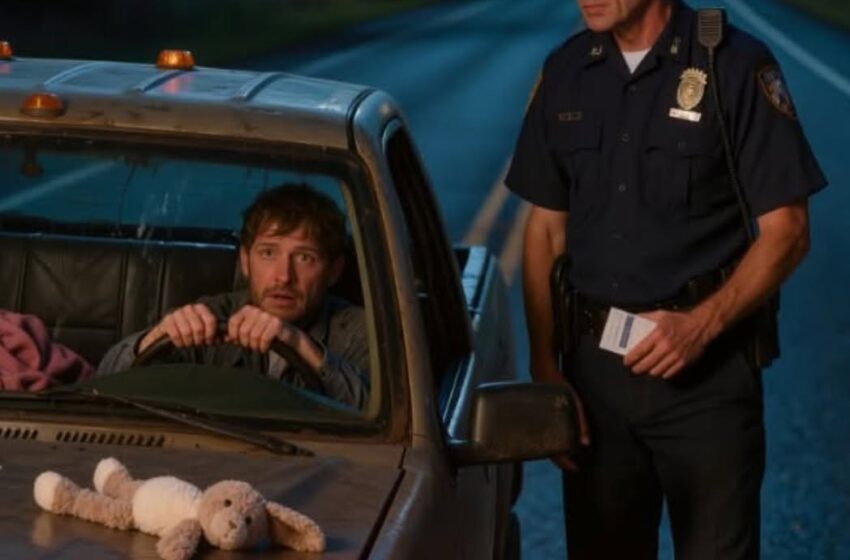
He had blown past me on a dark county highway, doing at least eighty-five in a fifty-five, tires kissing the center line, then jerking back.
Fifteen years in uniform teaches you how these stops usually go.
Beer on the breath.
Excuses.
Anger.
Sometimes lies so weak they almost insult you.
I walked up to his truck already reaching for my ticket book.
The driver rolled down the window, and I froze.
He wasn’t drunk.
He was crying so hard he could barely breathe.
Not loud crying.
The kind a grown man does when his body is trying to stay upright and failing anyway.
“My little girl,” he said, grabbing the steering wheel like it was the only thing keeping him alive. “They called from the children’s hospital. They said the treatment stopped working. They said I need to get there now.”
His voice cracked on the word now.
I looked into the back seat first.
No child.
Just a wrinkled pink blanket, a stuffed rabbit, and a paper envelope split open on the passenger seat. Bills. Hospital bills. The kind printed on heavy paper that somehow feels crueler in your hand.
He saw me glance at them and shook his head fast.
“I was at my second job,” he said. “I missed two calls because I was unloading boxes in the stockroom. I finally checked my phone and—” He swallowed hard. “Officer, please. Please.”
People can fake panic.
They can fake tears.
But there is a look that shows up only when someone is about to lose the center of their world.
He had that look.
I asked, “How far?”
“Twenty-two miles.”
Under normal traffic, maybe thirty minutes.
At that hour, with the lights and the railroad crossing and the downtown bottleneck, maybe more.
I looked at my ticket book.
Then I looked at him.
Then I folded the ticket book and slid it back into my pocket.
“Stay on my bumper,” I said.
He blinked at me like he didn’t understand.
I was already walking back to my cruiser.
When I hit the lights, the road turned red and blue.
When I hit the siren, everything changed.
I called it in, told dispatch I was escorting a private vehicle to the hospital for a child in critical condition.
There was a pause.
Then a quiet voice came back and said, “Go.”
So I went.
I cleared the first intersection at seventy.
The second at eighty.
Cars pulled aside. Brake lights flashed. Horns sounded somewhere behind us, angry and confused, but I didn’t care.
Every second felt expensive.
That’s what I kept thinking.
Not precious.
Expensive.
Like somewhere along the line in this country, even grief had become something people had to race against and pay for.
In my mirror, his truck stayed right behind me.
Too close sometimes.
Not close enough other times.
I kept talking over the radio, clearing lanes, calling lights, asking for cross traffic to be held where they could.
My hands were steady.
My jaw wasn’t.
Halfway there, we hit a long red light near the overpass.
Four lanes locked up.
No room.
I jumped the median, swung wide, blocked the oncoming turn lane with my cruiser, and forced a hole open with lights and noise.
He followed me through it like a man following the last breath in his body.
Subscribe to Tatticle!
Get updates on the latest posts and more from Tatticle straight to your inbox.
Website
Your Email…
Subscribe
We use your personal data for interest-based advertising, as outlined in our Privacy Notice.
We made it in fifteen minutes.
Maybe less.
I pulled hard into the hospital entrance and barely had the car in park before he was out of his truck.
He stumbled once.
Caught himself.
Then ran.
He didn’t thank me.
Didn’t look back.
Didn’t need to.
I sat there with the engine running and the siren finally dead, and all I could hear was my own breathing.
I should have gone back on patrol.
That would have been the proper thing.
But proper felt small right then.
So I stayed.
An hour passed.
Maybe a little more.
Nurses came and went through the sliding doors.
Families sat on benches with paper cups and empty faces.
A woman pushed a stroller with no child in it.
I have seen car wrecks, shootings, overdoses, house fires.
But hospital parking lots after midnight?
That is where you really learn what helpless looks like.
Eventually the man came back out.
He looked twenty years older than when I stopped him.
Not calmer.
Just hollow.
Like something inside him had already been carried away.
He saw my cruiser and stopped.
For a second, I thought maybe he hadn’t even remembered I was there.
He walked over slowly.
I stepped out.
I didn’t know what to say, so I asked the only thing that mattered.
“Did you make it?”
He nodded once.
His mouth trembled before any sound came out.
“Yeah,” he whispered. “She was still awake.”
I felt my throat close.
He looked down at his hands.
“She couldn’t lift her arms anymore,” he said. “But she moved her fingers when I held her hand.”
He took one shaky breath.
“She said, ‘Daddy, you came.’”
That one sentence hit harder than anything I have heard in fifteen years on this job.
He tried to thank me.
He really did.
He reached for my hand, but he didn’t make it that far.
His knees gave out, and he folded right into me like all the bones had gone out of him.
So I held him there in the hospital driveway while he cried into my shoulder.
A grown man.
Work boots.
Oil-stained jeans.
A hospital wristband they’d slapped on him at the desk.
Crying like the world had ended, because for him, it had.
I never wrote the ticket.
I never logged the speed.
If anyone asks, I’ll say I used my judgment.
Because sometimes the law is a line on paper, and sometimes duty is a father hearing “Daddy, you came” before the room goes quiet.
I’ve worn this badge for a long time.
Long enough to know that serving and protecting does not always look clean.
Sometimes it looks like broken rules.
Sometimes it sounds like sirens in the night.
And sometimes it means getting a man to his dying child before the healthcare bills, the long shifts, and the cruel timing of life steal the last five minutes he had left.
PART 2
Ten minutes after I held that man up in the hospital driveway, a nurse came through the sliding doors asking for the officer who brought him in.
I knew she meant me before she even looked my way.
There was something in her face I had seen before.
Not panic.
Not exactly.
It was that thin, strained look people get when they are trying to carry one more impossible thing without dropping it.
“The little girl is asking for you,” she said.
I stared at her.
“For me?”
She nodded.
“She heard the sirens when you pulled in. Her father told her you got him here.”
Behind her, the sliding doors kept opening and closing.
Families came through holding paper cups, blankets, each other.
The whole building smelled like coffee that had been sitting too long and air scrubbed so clean it somehow still felt dirty.
I looked toward the bench where the father had gone back inside.
“Is she…” I started.
The nurse gave a slow, careful shake of her head.
“She’s awake.”
Then, after half a second, “But I wouldn’t wait.”
That is how I ended up following a night nurse down a polished hallway at one-thirty in the morning, boots too loud on the floor, hat in my hands, feeling more nervous than I had the first time somebody shot at me.
There are places a uniform belongs.
Roadside shoulders.
School crossings.
Living rooms after break-ins.
Court hallways.
The room of a dying child is not one of them.
Every step felt borrowed.
At the end of the hall, the nurse stopped outside a half-open door.
I could see the father first.
He was sitting beside the bed, bent forward, one big hand wrapped around something small under a pink blanket.
His shoulders were shaking, but he was doing it silently now.
Trying not to scare her.
Trying to be the kind of strong nobody teaches you how to be.
The nurse touched my arm.
“Her name is Lila,” she said softly. “She’s seven.”
Seven.
I do not know why that number hit me harder than critical condition or treatment stopped working or any of the other words from earlier.
Maybe because seven is still loose teeth and crooked handwriting and knees scraped on playground bark.
Seven is still believing adults can fix things if they get there fast enough.
The nurse leaned in toward the doorway.
“Lila,” she said. “The officer is here.”
The father turned.
He looked wrecked.
Eyes red.
Face gray.
Mouth trying to hold itself together and failing.
He gave me one little nod like he was sorry for asking more of me after I had already done too much.
Then I heard her voice.
Small.
Dry.
Thinner than paper.
“Did Daddy get in trouble?”
That was the first thing she asked me.
Not hello.
Not who are you.
Not am I going to die.
Did Daddy get in trouble?
I stepped into the room.
The machines made soft, steady sounds around her bed.
There were tubes.
Tape.
A stuffed rabbit tucked under one arm.
She was all cheeks and eyes and blanket, like the rest of her had already started slipping somewhere the room could not hold.
I moved closer, but not too close.
“No,” I said. “He didn’t.”
Her eyes moved from me to her father.
“Because he was driving really bad.”
A sound came out of the father then.
Half laugh.
Half the front edge of another breakdown.
“I know, baby.”
She looked back at me.
“Was it because of me?”
That question went through me like cold metal.
I have had drunk men spit in my face.
I have had mothers scream at me over handcuffs on their sons.
I have stood in rooms with blood on the walls and still managed to keep my voice steady.
That little girl asking if her father’s fear was her fault nearly took me apart right there beside the bed.
“No,” I said, and I made sure the word landed clean. “It was because your daddy loves you very much and wanted to get here fast.”
She studied me like children do when they are deciding whether grown-ups are telling the truth or just trying to smooth something over.
Then she nodded once.
Like she had already known the answer and only needed one adult in a uniform to say it out loud.
“Okay,” she whispered.
The father bowed his head so hard his forehead nearly touched the bed rail.
Lila moved her fingers under his hand.
“Daddy.”
“I’m here, baby.”
“You came.”
He made a sound I hope I never hear from another human being again.
It was too broken to be a word.
Too grateful to be a sob.
He pressed her hand to his mouth and just stayed there.
I should have looked away.
Maybe I did, for a second.
I remember the bulletin board on the wall with cartoon stars and a paper moon.
I remember a wilted balloon in the corner that said GET WELL in bright letters cruel enough to count as a joke.
Mostly I remember feeling like every machine in that room was louder than it ought to be and not loud enough to cover what was happening.
Lila turned her face back toward me.
“Officer?”
“Yes, ma’am.”
That made the smallest smile touch one side of her mouth.
Kids like being called ma’am or sir when they are little.
It makes them feel taller.
“Did you use the loud thing?”
“The siren?”
She nodded.
“Yes.”
“With the spinny lights too?”
“Yes.”
“Did everybody move?”
I glanced at her father.
He had tears running off his chin onto the blanket and did not even seem to notice.
“They moved,” I said.
“Good.”
She shut her eyes for a second.
When she opened them again, she looked more tired.
Not sleepy.
Farther away.
“There was a train one time,” she said.
I looked at her father.
He swallowed.
“She hates the crossing by Willow Street,” he said quietly. “Says it takes forever.”
Lila lifted one finger off the blanket like she was making an important point.
“Tell them if it’s somebody’s daddy, they should move.”
Something in my chest tightened so suddenly I had to lock my knees.
“I’ll remember that,” I said.
She seemed satisfied.
Then she looked at the stuffed rabbit under her arm.
Its ears were worn thin at the ends.
One button eye had been sewn back on with pink thread instead of white.
She tugged weakly at it until her father helped slide it free.
“Her name is Marble,” Lila said.
I held out my hands automatically, but she did not give the rabbit to me.
Not yet.
“You can touch her,” she said.
I touched the rabbit’s ear.
The fabric was so soft from years of being loved it barely felt like cloth anymore.
Lila watched me do it.
Then she said, “If I don’t need her anymore, can you give her to another kid who has to stay here?”
Her father made a sharp sound.
“Lila—”
But she kept looking at me.
There are questions that do not have good answers.
There are promises you should not make in a room where life is shrinking by the minute.
I knew that.
I also knew there was no world in which I was going to look that child in the eye and talk around what she meant.
“If that’s what you want,” I said, “I’ll make sure Marble goes to a kid who needs a brave rabbit.”
She smiled again.
A little more this time.
Then she turned to her father.
“See?”
He nodded fast.
“Yeah, baby. I see.”
She lifted the rabbit a little higher.
“Not yet.”
“Okay,” I said.
She looked back at me once more, and her next question nearly dropped me where I stood.
“Do you have kids?”
I cleared my throat.
“A daughter,” I said. “She’s grown now.”
Lila thought about that.
“Does she still call you when she’s scared?”
See more on the next page