
He Broke the Rules to Deliver a Father to Goodbye in Time
- Stories
Cuisine And Stories
- 0
- 10 minutes read
I wished, with a force that embarrassed me, that she had not asked that in front of the nurse or her father or anybody at all.
The truth was my daughter and I talked mostly on birthdays, holidays, and the odd Sunday when one of us remembered first.
No fight.
No big falling out.
Just life doing what life does in this country.
Work.
Bills.
Schedules.
The quiet erosion of things you think will keep waiting for you.
“Not as much as she used to,” I said.
Lila’s eyes stayed on mine.
“You should tell her she can.”
That was it.
That was the moment I had to look down at the floor because if I had kept looking at her, I would have started crying in that room and never stopped.
“I will,” I said.
The nurse stepped closer to the bed then.
She was good at it.
Nothing rushed.
Nothing false.
Just gentle hands checking lines and monitors while pretending not to notice the way the room was changing.
Lila was breathing harder now.
Not faster.
Like each breath had more distance to travel than the one before it.
The father looked at me with wild, helpless eyes.
I did not know if he wanted me to stay or go.
I did not know what role I was still playing there.
Driver.
Witness.
Intruder.
But Lila solved that for all of us.
“Can he stay for one more minute?” she asked.
The nurse gave a tiny nod.
“One minute.”
Lila turned her face toward me again.
“Will you help my daddy when I’m not here?”
The room went still in a way I can still feel if I let myself.
The father shook his head hard.
“Baby, don’t talk like that.”
But she was past the point where adults can redirect children into safer words.
She knew.
Maybe not every medical detail.
Maybe not every stage and name and number.
But she knew enough.
Kids usually do.
I crouched so I was closer to eye level with her.
I had been given exactly one minute and no instruction manual.
“I’ll do what I can,” I said.
Her eyes moved to her father.
Then back to me.
“No,” she whispered. “Promise.”
I wish I could tell you I handled that with the wisdom of fifteen years on the job.
I did not.
I handled it like a man standing in front of a dying child who was asking him to guard what was left of her father after she was gone.
“I promise,” I said.
She shut her eyes.
The father made a broken, grateful noise into his sleeve.
The nurse touched my shoulder again.
Time.
I stood up slowly.
At the door, I looked back.
Lila had one hand under the blanket, still touching her father’s.
The other was resting on Marble.
For one strange second, she looked less like a sick child than a tiny queen in a too-big bed, deciding where the last pieces of her kingdom should go.
Then the nurse pulled the door nearly closed, and I was back in the hall with my hat in my hands and my whole body feeling wrong.
I made it to the restroom at the end of the corridor before I lost the fight with my face.
I stood over a sink and stared at myself in the mirror.
Same jaw.
Same crew cut.
Same badge on the chest.
But I did not look like the man who had stepped out of his cruiser on that county highway an hour earlier.
I looked older.
Not hollow.
Not yet.
Just cracked in places I had not known were fragile.
My phone buzzed in my pocket.
Dispatch.
I answered on the second ring.
“Mercer.”
My sergeant’s voice came through, low and tired.
“You still at the hospital?”
“Yeah.”
A pause.
Then, “Captain wants an incident summary before end of shift. Speeds. Route. Reason for escort. He got a call from county traffic because three cameras lit up all at once.”
Of course they did.
Roads are full of eyes now.
Signal poles.
Storefronts.
Dashcams.
Doorbells.
Everybody records everything except the part that happened inside a hospital room after the sirens stopped.
“Understood,” I said.
My sergeant hesitated.
Then he asked, “Kid make it?”
I leaned one hand on the sink.
From the hallway beyond the restroom, I could hear a cart rolling past and a man coughing somewhere far off.
“She was awake when he got there,” I said.
He let out a slow breath.
“That’s something.”
It was.
It was also nowhere near enough.
When I came back out, I did not go back to the room.
That minute had not belonged to me.
I stood in the hallway a while longer anyway, because leaving felt like its own kind of abandonment.
Around three, the father came out.
He did not see me at first.
He had Marble in one hand and a folded child’s drawing in the other.
He walked like he had forgotten where his feet were supposed to land.
When he finally looked up and found me by the vending machines, he stopped.
I thought he might pass right by.
Instead he crossed the hall slowly and held the drawing out to me.
“It’s for you,” he said.
His voice sounded scraped raw.
I took the paper.
It had been folded twice and then smoothed back open.
Crayon.
Purple, red, blue.
A police car with lights shooting out both sides.
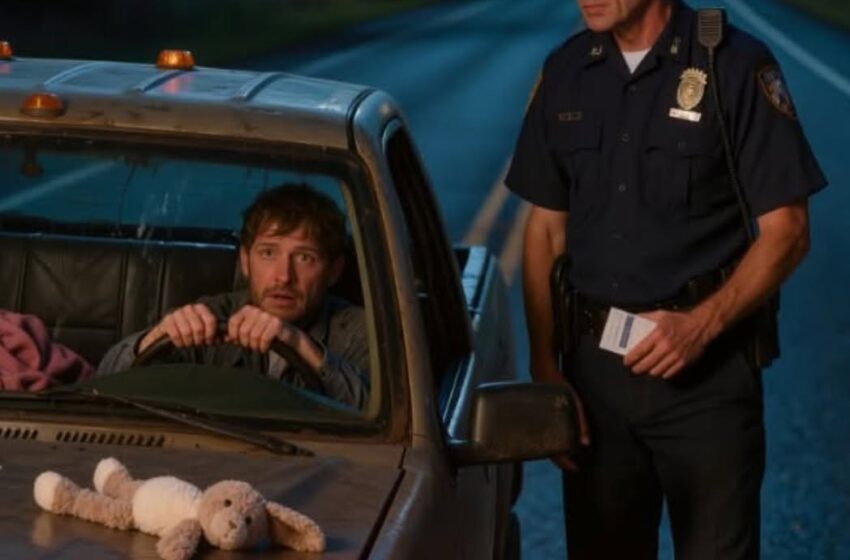
A pickup truck behind it.
Two crooked stick figures in the front windows.
At the top, in shaky block letters, it said:
HE GOT MY DADDY HERE.
My throat locked.
“When did she draw this?”
“She started it last week,” he said. “We kept telling her she’d get to go home soon. She said when she did, she wanted to ride with lights one day.”
He tried to smile and failed.
“She had me add the truck tonight. Said it wasn’t finished before.”
The paper shook in my hand.
“She wanted you to have Marble too,” he said quietly. “But she changed her mind.”
I looked at the rabbit tucked against his ribs.
“She said not yet?”
His eyes filled again.
“Yeah.”
He swallowed.
“Then she said maybe I need her first.”
For a second neither of us spoke.
Then the father looked over my shoulder toward the closed room door.
“They said it’ll be before dawn,” he said. “Maybe sooner.”
I did not know what a person says to that.
I still don’t.
So I said the only true thing I had.
“I’m sorry.”
He nodded.
“I know.”
Then he added, almost like he hated asking, “When they do whatever report they do on this… please don’t let them turn this into a story people pass around for entertainment.”
I looked at him.
“I won’t.”
“I mean it,” he said, voice tightening. “I can’t have strangers talking about her like she was some lesson or some headline. She was just my girl.”
“I said I won’t.”
He stared at me a second longer, making sure.
Then he nodded once.
“Thank you.”
He went back into the room.
At 4:17, I heard the father cry out through a closed door.
The sound did not last long.
That was somehow worse.
By 5:30, I was at my desk writing the report.
Date.
Time.
Weather.
Observed speed.
Vehicle description.
Dispatch authorization.
Everything the form wanted fit into neat boxes.
Nothing that mattered fit anywhere.
I wrote that I made a judgment call based on the driver’s verified statement that his minor child was in critical condition and time-sensitive access to the hospital was necessary.
I wrote that dispatch had been notified and that intersections were cleared where possible.
I wrote that I used emergency equipment to reduce travel time and prevent the private vehicle from taking unsafe evasive actions through traffic without escort.
That part was true.
He had been driving like a drowning man before I stopped him.
Once I was in front of him, at least the danger had shape.
Still, the words looked cold on paper.
Judgment call.
Verified statement.
Necessary.
There should have been another line under all of it.
Child asked if daddy got in trouble.
Child said tell them if it’s somebody’s daddy, they should move.
Child made it in time to say goodbye.
But there was no box for that.
At the bottom of the report, where it asked whether policy deviations occurred, I checked yes.
My sergeant took the pages without comment.
He read them standing up.
When he got to the bottom, his jaw moved once.
Then he set the papers down and rubbed a hand over his mouth.
“Captain’s gonna hate this.”
“He doesn’t have to like it.”
“That’s not what I mean.”
I knew what he meant.
You do a job long enough, you learn the difference between a thing being right and a thing being safe.
By noon I was in Captain Holloway’s office.
He had the report in front of him, glasses low on his nose, tie already loosened like he had been losing patience since dawn.
His office was clean in the way men keep things clean when they do not want to think about anything personal.
Framed commendations.
A service revolver shadow box.
One picture of two grown sons in baseball uniforms taken so long ago the edges had started fading.
He tapped the report.
“Tell me I’m missing something.”
“You’re not.”
“You used emergency equipment to escort a civilian vehicle at speeds above department threshold.”
“Yes, sir.”
“You crossed a median.”
“Yes, sir.”
“You blocked opposing traffic.”
“Yes, sir.”
He sat back and stared at me.
“Mercer, that is pursuit-level conduct without a pursuit. We have policy for a reason.”
“I know.”
“Do you?”
The question snapped harder than the others.
I kept my face still.
He leaned forward.
“I’m not asking if the situation was sad. I’m asking if you understood the liability of what you were doing.”
There it was.
Liability.
Not grief.
Not time.
Not the child.
The thing that survives every tragedy in America and always finds a chair at the table before the body is cold.
“Yes, sir,” I said.
“And you did it anyway.”
“Yes, sir.”
He stared at me a while longer.
Then he said, quieter, “Did the child make it?”
“She was awake when he arrived.”
“That isn’t what I asked.”
I thought of Lila asking if her father got in trouble.
I thought of the father begging me not to let strangers turn her into a story.
“She died before dawn,” I said.
Captain Holloway took off his glasses.
Something in his face shifted.
Not enough to save me.
Enough to remind me there was still a man underneath the rank bars.
He set the glasses down carefully.
“Traffic division got three calls last night,” he said. “Two from drivers forced onto shoulders. One from a woman in a minivan who says her son hit his head when she had to brake and swerve at the overpass.”
That landed harder than the rest.
“Is he okay?”
“As far as I’ve been told, yes. Seatbelt bruising. No hospital admission.”
I looked down at the floor for exactly one second.
One second was all I could afford.
Captain Holloway saw it anyway.
“That,” he said, “is why the policy exists.”
I looked back up.
“And the father getting there in time is why judgment exists.”
His jaw tightened.
See more on the next page